Sales Kickoff: Make It Change Monday's Calls, Not Just the Mood
Most sales kickoffs are judged by how the room felt. The real test is how reps sell three weeks later. What research says makes a kickoff stick.
A sales kickoff is the event, usually at the start of the sales year, where a company gathers its sellers to align on strategy, launch new messaging and build energy for the year ahead. Most are judged by how the room felt on the last day. The better test is whether reps sell differently three weeks later, and by that measure most kickoffs fall short.
That is the finding of a 2025 study by RAIN Group and Alchemist, which surveyed more than 220 sales leaders, enablement professionals and sellers. Even among organizations whose kickoff was rated highly effective, only one in five report very strong seller behavior impact. People loved the event. Most of them did not sell differently because of it.
Five circles in a row stand for organizations whose sales kickoff was rated highly effective. One is gold: only 1 in 5 of them report a very strong change in how their sellers sell. The circles then split: four gather under Loved the event, and the gold one moves alone under Changed how they sell.
Source: RAIN Group and Alchemist, The SKO Shakeup. Study of more than 220 sales leaders, enablement professionals and sellers, 2025
Why does the energy fade so fast?
The research report puts it plainly: sellers leave motivated for a few days, but the impact fades quickly. Anyone who has run a kickoff has seen it. The slides are good, the dinner is better, and by the second week of the quarter the old talk track is back.
The reason is simple. A kickoff changes what reps know. It does not, on its own, change what they do when a buyer pushes back on price at 2:40 on a Thursday. That moment happens alone, on a live call, far from the ballroom. Whatever the rep can recall in that moment is what the kickoff actually delivered.
This is the same problem every form of sales training runs into, and it is why real-time sales coaching has become its own discipline. Knowledge that is not available during the call does not shape the call.
What separates a kickoff that sticks?
The study looked at what high-impact kickoffs do differently. A few findings stand out for anyone planning one now.
They are tied to strategy. High-impact kickoffs are 1.8 times more likely to be tightly linked to company strategy. Not a theme and a tagline, but a short list of things the company needs sellers to do differently this year.
They make sellers practice. Sellers in high-impact kickoffs are 2.8 times more likely to spend considerable time engaging in realistic role-plays. Practice is where a new message stops being a slide and starts being something a rep can say out loud.
They go light on keynotes. Executive keynotes often fill the agenda, yet in the full report only 29% of respondents with highly effective SKOs strongly agreed that keynotes contributed to achieving goals, a lower rate than for team-building, sales training workshops and customer success stories.
A kickoff is a launch, not a finish line. The work it starts happens on calls.
What happens after the event matters more
The biggest gap the study found was not inside the event. It was after it. Less than 50% of organizations have a formal reinforcement plan, and low-performing kickoffs are 3.3 times more likely not to track success.
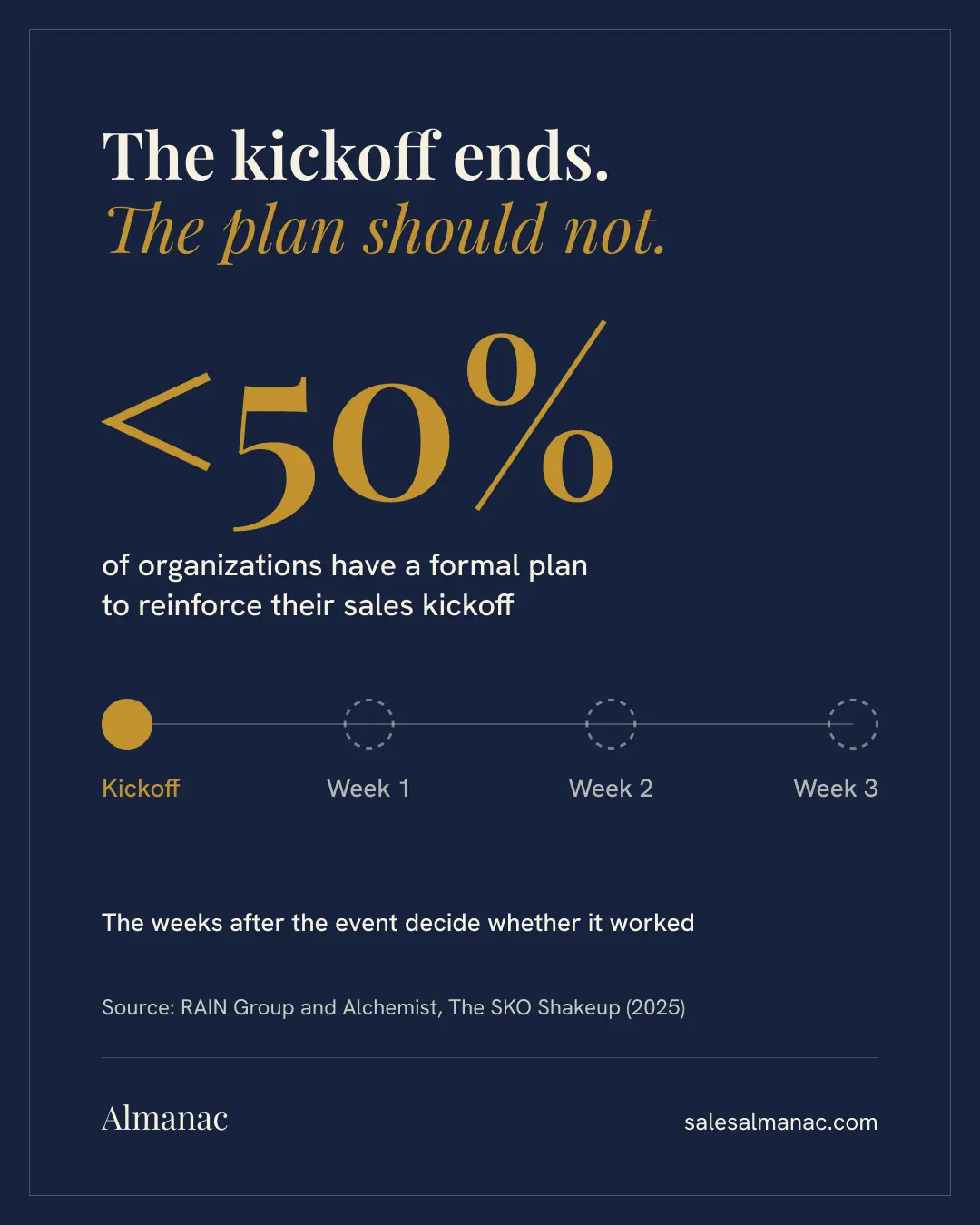
Put those two findings together and the pattern is clear. Many teams spend months planning two days, then plan nothing for the weeks that decide whether those two days paid off. Nobody checks whether the new discovery questions are being asked. Nobody notices that the new pricing story never made it into a single call.
Reinforcement does not have to be elaborate. It needs three things: the new behaviors written down, a way to see whether they show up on calls, and a manager who coaches against them. If your team already runs a weekly sales call coaching rhythm, the kickoff should feed it directly.
How to plan a sales kickoff agenda that changes calls
If you are building a sales kickoff agenda for January, these ideas keep the focus on what reps will do afterward.
- Pick three behaviors, not thirty topics. Decide which few things you want to hear on calls in February. A new opening question, a sharper answer to the top objection, a clearer next step. Everything on the agenda should serve one of them.
- Write the words down before the event. If the new messaging lives only in a keynote, every rep will remember a different version. Put the exact questions and answers in the team’s playbook so there is one source.
- Trade a keynote for practice. Give reps time to run the new talk track in realistic role-plays, with feedback, before they try it on a buyer.
- Plan the first three weeks after. Schedule the coaching sessions, the call reviews and the check-ins before the kickoff, not after it.
- Decide how you will know. Choose a simple signal, such as how often the new question is asked on calls, and look at it every week.
None of this makes the event less fun. It makes the event count. New hires starting in the same quarter benefit too, since a clear playbook shortens the sales onboarding process for them as well.
Where Almanac fits
Almanac keeps the kickoff’s message alive where it is used: on the call. The team’s playbook is built from your PDFs, Word docs and URLs, so the new messaging goes in once and every rep gets it on their next call. During the call, answers and the next question from that playbook appear on the rep’s screen, visible only to the rep.
Before the event and after it, reps can practice in the Trainer, role-playing the new pitch against a live AI buyer built from your personas and objection library. After each call, a scored debrief shows managers which of the new behaviors are showing up and which still need coaching.
Frequently asked questions
What is a sales kickoff?
A sales kickoff, often called an SKO, is an event where a company’s sales team gathers, usually at the start of the year, to align on strategy, learn new messaging and build momentum. It can run in person, virtually or as a hybrid.
What should be on a sales kickoff agenda?
Start with the company strategy and the few selling behaviors it requires, then give most of the time to practice: role-plays, workshops and customer stories. Research by RAIN Group and Alchemist found high-impact kickoffs are 2.8 times more likely to include considerable time on realistic role-plays.
How do you measure whether a sales kickoff worked?
Look at behavior on calls in the weeks after, not satisfaction scores on the last day. Pick one or two signals tied to what the kickoff taught, such as how often reps use the new discovery questions, and track them with manager feedback.
How do you reinforce a sales kickoff afterward?
Put the new messaging in one shared playbook, schedule coaching and call reviews for the first few weeks, and give reps more chances to practice. Fewer than half of organizations have a formal reinforcement plan, so having one is already an advantage.