Sales Call Coaching: Why Monday's Feedback Can't Save Thursday's Call
Sales call coaching works in two places: during the call and after it. What live guidance and post-call review each fix, and how to run both.
Sales call coaching happens in two places: during the call, and after it. Coaching after the call, when a manager replays a recording and gives feedback, builds skill over weeks. Guidance during the call fixes the moment itself, while the buyer is still listening. Neither replaces the other. The teams that coach well give each one the job it does best, and they stop asking a Monday review to rescue a Thursday call.
Most teams still lean on the review alone. That is the gap this piece is about. For the full case for in-the-moment help, see our guide to real-time sales coaching.
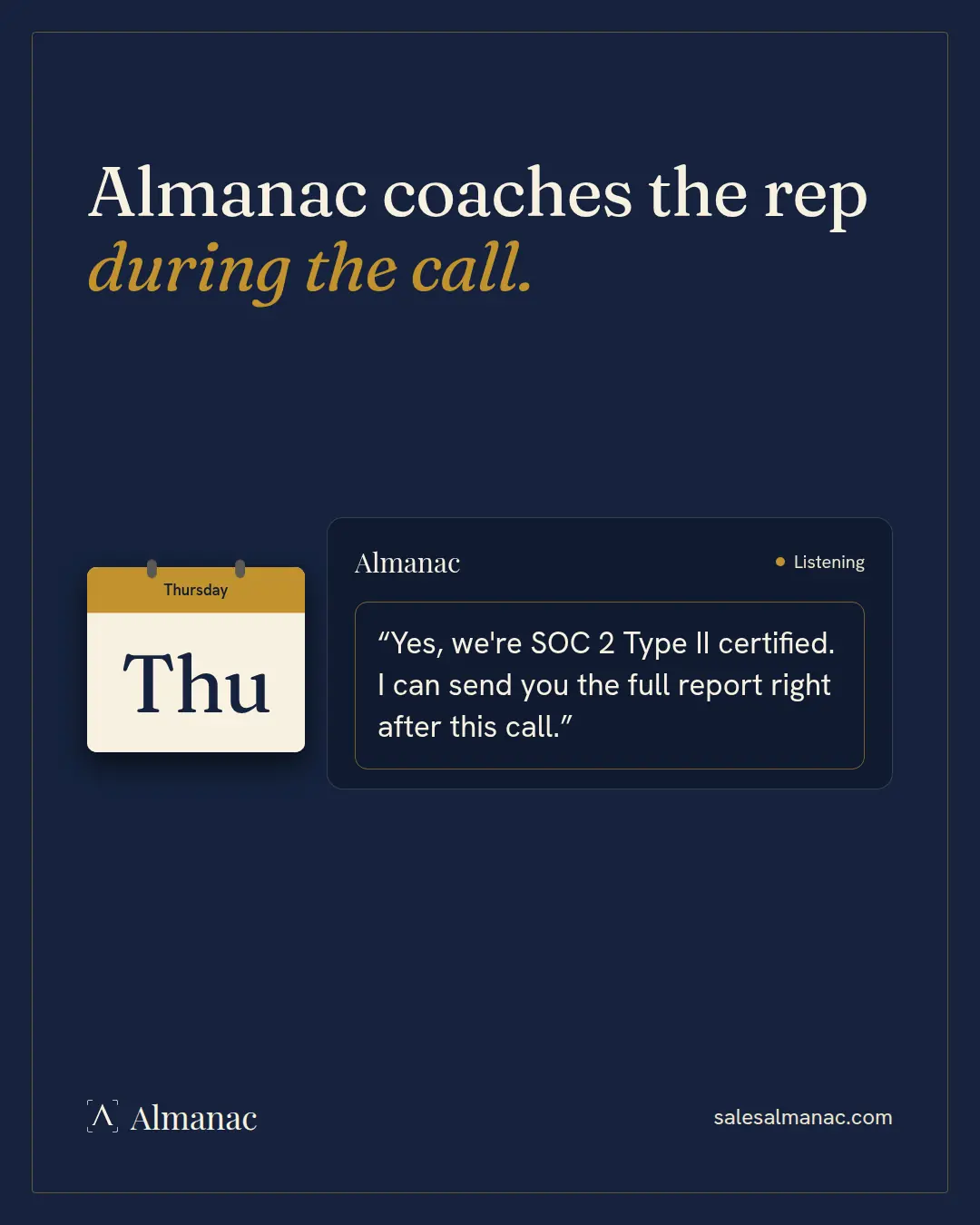
A desk calendar reads Monday. On Thursday's call the buyer asked about security and the rep said I'll follow up; on Monday the manager replays the call and says next time, send the one-pager. The calendar pages then flip back to Thursday, and the same advice appears on the rep's screen during the call: send the one-pager now.
Source: Almanac illustration. A composite example, not a specific call
Coaching has a timing problem
Picture a normal week. On Thursday, a buyer asks how the product handles security. The rep is not sure, so they say the safe thing: “I’ll follow up.” The call moves on. The buyer’s attention moves on with it.
On Monday, the manager replays the call. The advice is good. “Next time, send the one-pager.” The rep agrees. But the buyer who asked is already four days down the road, and the moment that mattered is gone.
Nothing in that story is anyone’s fault. The manager did the job. The rep learned something. The coaching was simply late. It arrived after the only call it could have helped. And the call it missed was rare to begin with: Salesforce’s 2026 State of Sales report found the average seller spends just 40% of their time selling.
Sales call coaching is the work of helping a rep handle real conversations better. Timing decides what kind of help it can be. Feedback after the call can change the next one. Only guidance during the call can change this one.
What a call review does well
Post-call coaching is still where reps grow. A good review looks past one answer to the pattern behind it. Why did the rep rush to price? Why did they stop asking questions once the buyer sounded interested? Those are questions of judgment, and judgment is built slowly, with a manager who has seen the same mistake on a hundred calls.
The review also gives reps something live guidance cannot: practice. Rehearsing a hard conversation before it happens, with someone playing the buyer, is how reps build the instincts no screen can supply.
Many reps say they do not get enough of either. In Salesforce’s 2026 State of Sales report, a survey of 4,050 sales professionals, 46% of Gen Z reps said they rarely get feedback on their sales conversations, and 47% said they don’t get enough roleplay before customer calls. Asked what stands in the way, Gen Z reps named a lack of manager time first.
That is the real limit of the review. It runs on the manager’s calendar, and the calendar is full.
What only live guidance can do
Live guidance does a narrower job, and does it at the only moment it counts. When the buyer asks about security, the rep needs a fact, not a lesson. Which certification do we hold? Is there a document to send? What should I ask next?
Those answers already exist somewhere on the team. They sit in a security one-pager, a pricing sheet, a product note from last quarter. The trouble is finding them in the four seconds before the silence gets awkward. That is why the rep says “I’ll follow up.” It is not a skill problem. It is a recall problem.
Put the answer on the rep’s screen the moment the buyer asks, and the same Thursday call ends differently. The rep sends the one-pager before they hang up. The buyer’s question gets answered while it still matters. There is nothing to fix on Monday.
When an answer truly is not available, honesty beats bluffing. Our guide on what to do when you don’t know the answer covers how to handle that moment without losing the room.
Most coaching is left to chance
The bigger risk is not which kind of coaching a team picks. It is having no system at all.
Korn Ferry’s recent research found that 62.9% of organizations still let managers use an ad hoc or informal coaching approach. The minority with a “dynamic” approach, one linked to training and content, won an average of 55.2% of forecast deals. Organizations that left coaching to each manager’s discretion won 41.8%.
The lesson is not that managers coach badly. It is that coaching works better as part of a system than as a favor squeezed between meetings. The best coaching is tied to what the team already knows, delivered the same way every time, and not dependent on one person having a free hour.
If the same note comes up in two reviews, it belongs in the call, not the review.
How to split the work between the call and the review
The simplest rule is to sort coaching by what kind of help it is. Facts belong in the call. Judgment belongs in the review.
- Put facts in front of the rep, live. Product answers, security details, pricing rules and the next good question should never depend on memory. If a rep could look it up, they should not have to.
- Save the review for judgment. Use the replay to talk about choices: when to push, when to listen, how to read a quiet buyer. That is where a manager’s experience pays off.
- Practice before the call that matters. A short roleplay before a big meeting does more than a long review after it. It is also the help 47% of Gen Z reps say they lack.
- Close the loop. When a review turns up a missing answer, add it to the material reps see live. The next rep who hears that question gets it on screen, and the manager never has to give that note again.
Run this way, the two kinds of coaching stop competing for the same hour. Live guidance handles the questions that have answers. The review handles the ones that don’t. New reps feel it most, which is also why ramp time is where coaching gaps get expensive.
Where Almanac fits
Almanac covers both sides of that split. Before a call, it builds a short brief: what is already known, what is still missing, and who in the room already has the story. During the call, it puts answers and the next question from your team’s playbook on the rep’s screen, visible only to the rep. After the call, it writes a scored debrief and drafts the follow-up email and handoff docs.
For practice, the Trainer lets reps roleplay against a live AI buyer built from your team’s personas and objection library. And the playbook itself is built from the PDFs, Word docs and links you upload, so when a review turns up a better answer, the update reaches every rep on their next call.
Frequently asked questions
What is sales call coaching?
Sales call coaching is the work of helping reps handle real sales conversations better. It happens in two places: during the call, with live guidance, and after it, when a manager reviews the recording and gives feedback. Strong programs use both.
Is real-time coaching better than post-call coaching?
They do different jobs. Real-time guidance helps with facts and next steps while the buyer is still on the call. Post-call coaching builds judgment and skill across many calls. Teams get the most from giving each one the work it suits.
How often should managers give feedback on sales calls?
There is no single right number, but regular and structured beats occasional. Korn Ferry found that organizations with a dynamic coaching approach won 55.2% of forecast deals, compared with 41.8% where coaching was left to each manager’s discretion.
Do new reps need more call coaching?
Usually, yes, and many say they get less than they need. In Salesforce’s 2026 State of Sales report, 46% of Gen Z reps said they rarely get feedback on their sales conversations, and 47% said they don’t get enough roleplay before customer calls.