Average Account Executive Tenure Is 3.2 Years. Should You Build Experience or Buy It?
Average AE tenure is 3.2 years, ramp is 6.2 months and the experience bar is 3.7 years. Why buying experience no longer buys a faster start.
Average account executive tenure is 3.2 years. That is the finding of The Bridge Group’s 2026 AE research report, which surveyed 158 B2B companies. Tenure is up from 2.8 years in 2024 and 2.2 years in 2022. But a new AE takes 6.2 months to reach full productivity, the longest ramp in the study’s history. Subtract the ramp from the tenure and a company gets about 32 months of full-speed selling from a typical hire.
Companies have responded by hiring for experience. The average AE now needs 3.7 years of it to get hired, up from 2.7 in 2022. The question every sales leader faces is whether that experience is better bought or built. The numbers suggest buying it has stopped doing the job it used to.
A column stands for the 3.2 years an average account executive stays. The top band, 6.2 months, is ramp. The rest, about 32 months, is time at full productivity. The ramp band then shrinks while the column stays the same height, and the months it gives up turn into selling months.
Source: The Bridge Group, AE Models, Motions & Metrics 2026 report. Average tenure and ramp, 158 B2B companies. Productive months are tenure minus ramp
How long do account executives stay?
An account executive stays about 3.2 years on average, according to The Bridge Group. That is a real recovery. In 2022, at the height of the job-hopping years, the average was 2.2 years. The report also finds that the share of AEs with three or more years in the seat has nearly tripled since then.
Fewer people are leaving, too. Median annual turnover fell to 21%, from 30% in 2024. Quits alone dropped to 9%, from 20% in 2022. The report reads this as a “low hire, low fire” job market, not a sudden rise in loyalty.
Tenure is only half of the story, though. What a company really gets from a hire is the time between the end of ramp and the day they leave. At 3.2 years, or about 38 months, minus 6.2 months of ramp, that window is roughly 32 months. Every hiring and coaching decision either widens it or narrows it. Our hub on real-time sales coaching looks at the narrowing side: how much of ramp happens on live calls.
The experience bar rose a full year
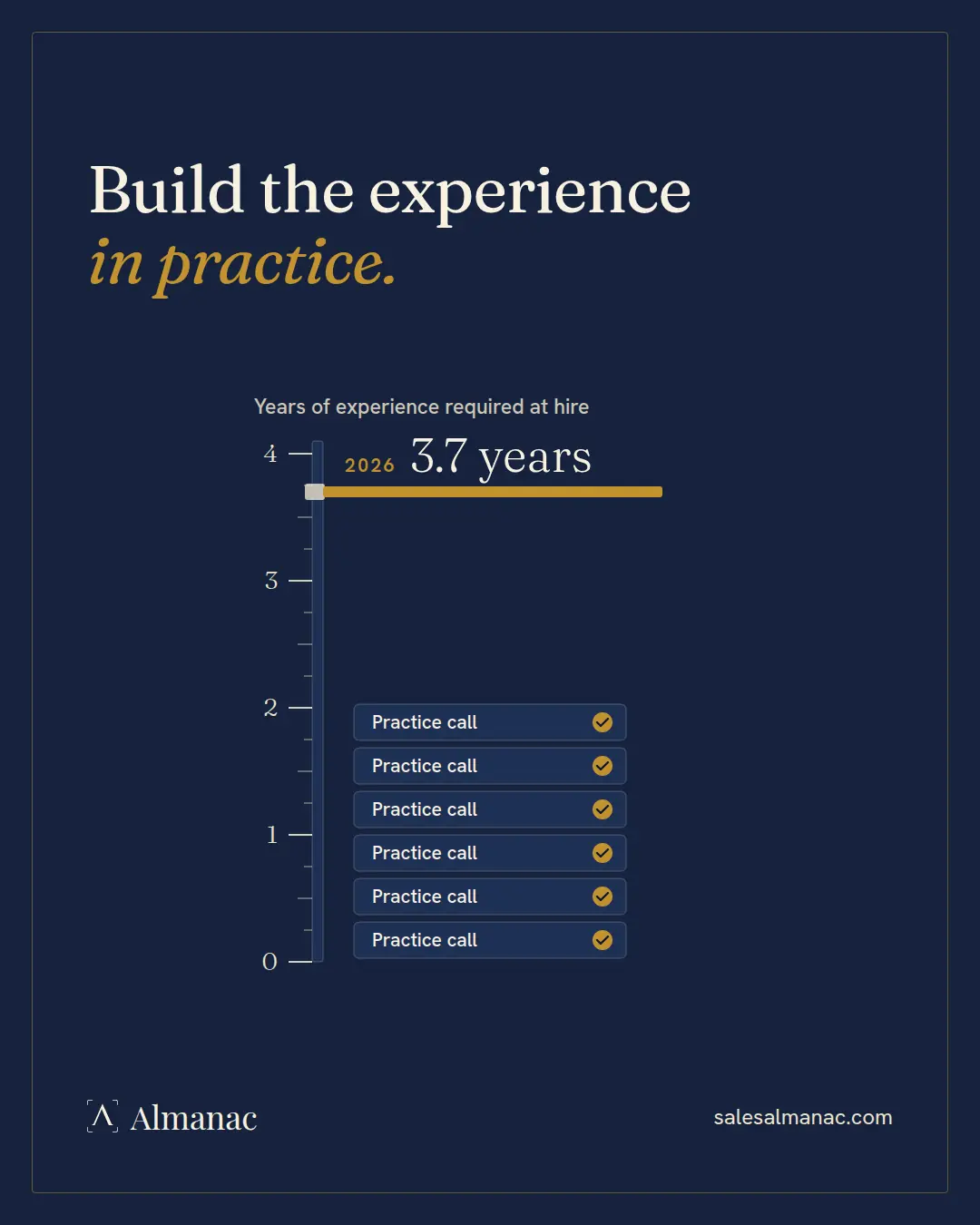
Companies now ask for 3.7 years of experience, on average, before they hire an AE. In 2022 they asked for 2.7. The share of companies requiring three or more years has nearly doubled over the same period.
Two bars. Companies required 2.7 years of experience to hire an account executive in 2022 and 3.7 years in 2026. The 2022 bar then turns into average account executive tenure, 3.2 years, which is shorter than the 3.7 years of experience now asked for at hire.
Source: The Bridge Group, AE Models, Motions & Metrics 2026 report. 158 B2B companies, surveyed in 2026
The Bridge Group’s own summary is blunt: “At higher ASPs, the era of the junior AE appears largely over.” The report ties the trend to a market that favors employers and to rising ramp costs. Selling has also gotten harder. Compared with early 2025, near majorities of the leaders surveyed report more stakeholders per deal, longer sales cycles, more pressure to discount and more deals slipping.
Put the two numbers side by side and something odd appears. Teams ask for 3.7 years of experience. The average AE stays 3.2. In effect, companies are asking each new hire to bring more than a full tenure’s worth of selling from somewhere else.
Buying experience has not bought a faster start
If hiring experienced reps shortened ramp, the trade would make sense. It has not. The same report that shows the experience bar rising shows ramp at 6.2 months, up from 5.7 in 2024 and 5.3 in 2022. Teams are paying for more experience and still waiting longer for full output.
The reason is simple. Experience carries over, but it does not carry everything. A rep with four years elsewhere knows how to run a discovery call. They do not know your product’s limits, your pricing rules, your strongest proof points or the three objections that kill your deals. That knowledge has to be built, no matter whom you hire.
So “build or buy” is a false choice. Every company builds. The only question is how fast, and whether the building happens in a classroom, in a manager’s spare hour or on the call itself.
Every company builds experience. The only choice is how fast.
Where the productive window really grows
There are two ways to widen the productive window. Keep people longer, or ramp them faster. Tenure moves slowly and depends on things a sales leader does not fully control: the job market, the company’s growth, a rep’s next offer. Ramp is different. It is mostly a function of how a team trains.
Every month cut from ramp becomes a month of selling, and tenure does not have to change at all. Our guide on how long it takes to ramp a sales rep puts a price on each of those months.
The training gap is real. Salesforce’s 2026 State of Sales report found that among Gen Z sellers, 46% rarely get feedback on their sales conversations and 47% do not get enough roleplay before customer calls. They name a lack of manager time as the biggest obstacle. Those are the reps companies are now reluctant to hire, and the gap is the reason why.
What building experience looks like now
Building experience used to mean a long onboarding program, then months of learning on live deals. Teams that ramp well tend to do three things differently.
- Practice before the call that counts. A new rep should hear your hardest objections in rehearsal first. Roleplay against realistic buyers turns a first live call into a second attempt.
- Put the playbook where the rep is. A playbook in a shared drive helps the reps who remember to open it. The knowledge that matters needs to be on screen during the conversation, when a buyer asks the question. Our guide on what to do when you don’t know the answer covers that moment.
- Give feedback on every call, not a sample. A manager can review a few calls a week. A new rep makes many more. Feedback that arrives the same day, on every call, compounds faster than a monthly review.
None of this replaces hiring good people. It makes the people you hire productive sooner, whatever their résumé says.
Where Almanac fits
Almanac is built to shorten the part of the window that ramp takes. Before each call, it builds a brief that shows what is already captured, what is still missing and who in the room already has the story. During the call, it puts answers and the next question from your team’s playbook on the rep’s screen, visible only to the rep. In the Trainer, reps role-play against a live AI buyer built from your personas and objection library.
After the call, Almanac writes a scored debrief, drafts the follow-up email and prepares handoff docs. The playbook itself is built from the PDFs, Word docs and URLs your team already has, and an update reaches every rep on their next call.
Frequently asked questions
What is the average tenure of an account executive?
About 3.2 years, according to The Bridge Group’s 2026 AE report, a survey of 158 B2B companies. That is up from 2.8 years in 2024 and 2.2 years in 2022. Median annual turnover fell to 21% over the same period.
How many years of experience do you need to be an account executive?
Companies require 3.7 years of experience on average to hire an AE, up from 2.7 years in 2022, according to The Bridge Group. Requirements rise with deal size. At higher price points, the report says, the era of the junior AE appears largely over.
How long does it take a new account executive to ramp?
The average AE takes 6.2 months to reach full productivity, the longest The Bridge Group has recorded. Ramp was 5.7 months in 2024 and 5.3 months in 2022, even as companies hired more experienced reps.
How many productive months do you get from an account executive?
Roughly 32. Average tenure of 3.2 years is about 38 months, and 6.2 of those are ramp. Cutting ramp is the most direct way to add productive months, because it does not depend on the rep staying longer.