A Sales Rep Development Plan for the Year After Onboarding
A sales rep development plan for the 12 months after onboarding, when reps go from ready to top performer, and the three habits that get them there.
A sales rep development plan is the plan for how a rep keeps getting better after onboarding ends. It matters because onboarding ends early. In a RAIN Group survey of 423 sales leaders, a new seller takes about three months to be ready to talk with buyers, nine months to be competent and 15 months to become a top performer. Most of the climb happens after the training is over.
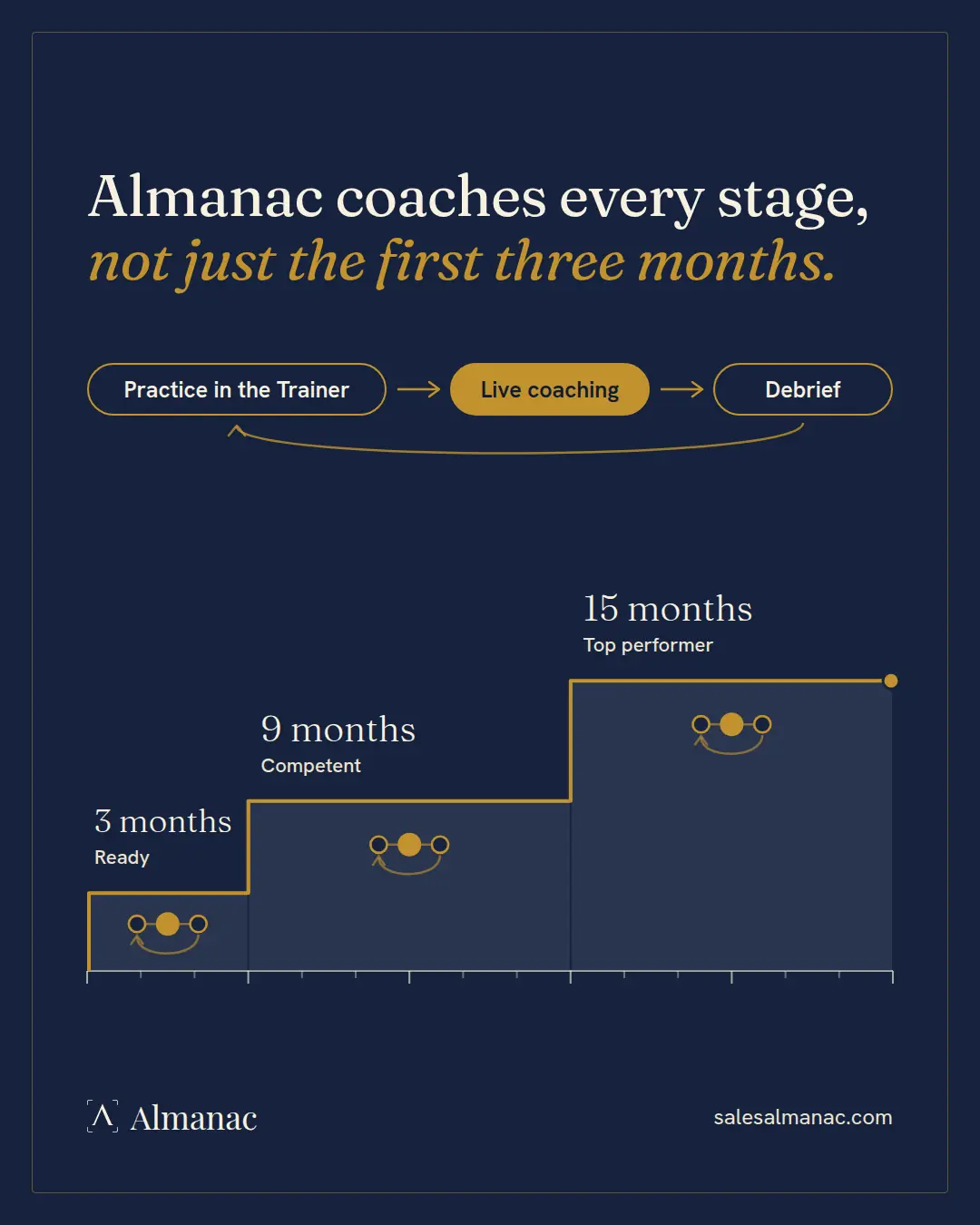
A good plan covers that whole climb. It sets a goal for each stage and keeps three habits running the entire way: practice before calls, coaching on real calls, and a debrief after every call.
A staircase of three steps. A new rep is ready to interact with buyers at about 3 months, competent at 9 months and a top performer at 15 months. Each step then splits into the same three layers, practice, live coaching and a debrief, showing that development continues at every stage, not just in the first months.
Source: RAIN Group, Sales Rep Onboarding: How Long Does It Really Take?
Onboarding gets a rep to ready. That is month three of fifteen.
Onboarding teaches a new hire the product, the process and the pitch. It ends when the rep is fit to be put in front of a buyer. By RAIN Group’s numbers, that is about three months in.
The trouble is what happens next. In many teams, the structure ends with onboarding. The rep gets a quota and a calendar, and development turns into whatever the manager has time for that week. Yet by the same survey, the rep still has about a year to go before reaching top performance.
That year is where a development plan does its work. RAIN Group’s advice is to build a curriculum that grows skills over time: train them, reinforce them, “teach additional skills at timed steps, and hold sellers accountable for using these skills.” If you want the cost side of the early months, our guide on how long it takes to ramp a sales rep covers it. This piece is about everything after.
What a sales rep development plan should contain
A sales rep development plan should name the stage the rep is in, the two or three skills that move them to the next one, and how those skills get practiced and checked. It should fit on one page. If it needs a binder, nobody will open it.
Four things belong in it:
- The stage and the target. Ready, competent or top performer, and what the next stage looks like for this rep in this role.
- Two or three skills, no more. Pick the ones that show up in real calls, such as discovery questions or handling a pricing objection.
- The habits that build them. When the rep practices, how they get coached and when they debrief.
- A monthly check. A short look at real calls against the skills, not a review of activity counts.
The last point matters most. A plan that is reviewed once a year is a document. A plan that is checked against real calls every month is a habit.
The three habits that work at every stage
Skills change from stage to stage. The way reps build them does not. Three habits carry the whole climb.
Practice before the call. Rehearse the hard moments before a buyer is on the line: the objection, the tough question, the moment the call goes quiet. Practice is cheap and private. It is also scarce. Salesforce’s 2026 State of Sales report found 47% of Gen Z reps don’t get enough roleplay before customer calls.
Coaching on real calls. Feedback works best close to the moment it describes. Guidance during the call, or right around it, beats a note from a review two weeks later.
A debrief after every call. Five minutes, right after the call ends. What went well, what to try next time, and one thing to practice before the next call. This is how a single call becomes a lesson. Salesforce found 46% of Gen Z reps rarely get feedback on their sales conversations.
Rhythm is the point. RAIN Group’s research on sales management found top performers are 51% more likely to have regular, ongoing coaching. Coaching that happens on a schedule, every week, beats coaching that happens when a deal is in trouble.
What changes from ready to top performer
The habits stay the same. What a rep works on changes as they climb.
From ready to competent. The rep can hold a conversation. Now they need to run one. Focus on discovery, on listening more than talking, and on answering the common questions without stalling. When a question is out of reach, the rep needs a plan for that too; here is what to do when you don’t know the answer. Practice is heavy here, because most moments are still new.
From competent to top performer. The rep can run a call. Now they need to shape a deal. Focus on multiple buyers, on pricing conversations that hold value, and on moving a stalled deal forward. Debriefs carry more weight here, because the lessons are subtler and easier to miss.
After top performer. Development does not stop at the top. Markets change, products change, and so do buyers. The best reps keep practicing new material and keep reviewing their own calls. They also make good coaches for the reps a step behind them.
Onboarding gets a rep to the first step. A development plan gets them up the rest.
Development is how you keep the reps you hired
A development plan is not only a performance tool. It is a retention tool. In Salesforce’s 2026 research, Gen Z reps were more open to leaving their jobs than any other generation, and they named a lack of advancement opportunities as the main reason.
The same report points to the bottleneck. Asked what gets in the way of effective enablement, Gen Z reps named a lack of manager time as their top obstacle. That is the honest constraint for most teams. No manager can sit in on every call.
So the plan has to work in the gaps. Practice the rep can do alone. Coaching that reaches the call even when the manager is not on it. A debrief that happens whether or not anyone schedules one. The manager’s time then goes where it counts most: the monthly check and the hardest deals.
Where Almanac fits
Almanac is built for those three habits. In the Trainer, reps role-play against a live AI buyer built from your team’s personas and objection library, so practice is there whenever they have ten minutes. During a call, Almanac shows answers and the next question from your team’s playbook on the rep’s screen, visible only to the rep. After the call, it writes a scored debrief, drafts the follow-up email and prepares handoff docs.
Before each call, a short brief shows what is already known and what is still missing. And when you update the playbook from your own PDFs, Word docs or web pages, the change reaches every rep on their next call.
Frequently asked questions
What is a sales rep development plan?
It is a short, written plan for how a rep improves after onboarding. It names the rep’s current stage, the two or three skills that move them to the next one, and how those skills will be practiced, coached and checked each month.
How long does it take a sales rep to become a top performer?
About 15 months on average, according to a RAIN Group survey of 423 sales leaders. The same survey puts a new rep at ready to interact with buyers at about three months and competent at about nine.
How is a development plan different from onboarding?
Onboarding teaches a new hire the basics and gets them ready for buyers, usually in the first few months. A development plan picks up where onboarding stops and runs for as long as the rep is in the role, with goals that change at each stage.
How often should a development plan be reviewed?
Check it monthly against real calls, and keep the habits underneath it weekly or daily. RAIN Group found top performers are 51% more likely to get regular, ongoing coaching, so a steady rhythm matters more than a long annual review.