Sales Enablement Content: What Works, and Why Reps Don't Use It on Calls
Reps say sales enablement content matters, yet few open it while the buyer is talking. What to build, and how to get it to reps in the moment.
Sales enablement content is everything a team gives its reps to help them sell: talk tracks, battlecards, case studies, pricing guides, product one-pagers and answers to the questions buyers ask most. Reps value it. In HubSpot’s 2024 Sales Trends Report, 52% of sales pros said they use sales enablement content, and 79% of those said it is important to making a sale. The trouble is when they can reach it. The moment a rep needs an answer is usually the moment a buyer is talking, and nobody opens a deck mid-sentence.
So the content gets used before calls and after them. During the call, where deals are won or lost, the rep is on their own.
A shelf of sales documents: pitch deck, one-pager, battlecard, case study, pricing guide and demo script. 52 percent of sales pros use sales enablement content. The documents then slide off the shelf and condense into three short cards, talk track, objection and answer, in the side panel of a live call. 79 percent of those who use sales enablement content say it is important to making a sale.
Source: HubSpot, 2024 Sales Trends Report. Survey of 1,400+ sales professionals, August 2023
What is sales enablement content, and what counts?
Sales enablement content is any material built to help a rep move a deal forward. Some of it is for buyers, like case studies and demos. Some of it is for the rep alone, like talk tracks, objection answers and competitive notes. What ties it together is purpose: it exists to make the next conversation go better.
HubSpot’s report lists the types sales pros found most effective for winning deals, led by social media content, market research, reviews, customer testimonials and product demos. Here is when a rep needs the common types.
A timeline of a sales call in three steps. Before the call: demo scripts. During the call: talk tracks, objection answers, battlecards, product and technical answers, case studies, pricing guides and demo scripts. After the call: case studies and pricing guides. Every type is needed during the call.
Grouping by Almanac, based on how sales teams typically use each type
Talk tracks frame the problem in the team’s words. Objection answers handle price, timing and “we already have a tool.” Battlecards position against the alternative a buyer names, and product answers cover specs, integrations and security. Case studies and pricing guides do double duty: mentioned live, then sent in the follow-up.
Look at the middle of that timeline. Every one of these types is needed live at some point, while the buyer is talking.
Why don’t reps use sales enablement content on live calls?
Reps don’t use it on calls because it lives in the wrong place at the wrong time. It sits in a shared drive, a portal or a slide deck. Finding the right page takes a search, a scroll and a few seconds of silence. On a live call, those seconds feel long, so most reps guess, stall or promise to follow up instead.
This isn’t a problem of effort. Companies spend real money on enablement. Gartner’s research shows the return falling short.
A grid of 100 squares labeled sellers, with 77 gold: 77 percent of sellers struggle to complete their assigned tasks efficiently despite investment in sales enablement. The grid then recolors and is labeled sales leaders, with 82 navy: 82 percent of sales leaders say sales enablement content or delivery must significantly change to meet revenue goals.
Source: Gartner, press release, November 2, 2023. 501 sellers surveyed March to April 2023; 213 sales leaders surveyed November to December 2022
In a Gartner survey of 501 sellers in 2023, 77% reported that they struggle to complete their assigned tasks efficiently, despite their organizations investing in sales enablement. In a separate Gartner survey of 213 senior sales leaders, 82% said sales enablement content or delivery must significantly change to meet revenue goals in five years.
Part of the reason is load. A 2024 Gartner survey of 1,026 B2B sellers found 72% feel overwhelmed by the number of skills their job requires, and overwhelmed sellers are 45% less likely to attain quota. More pages in the library only add to the pile a rep has to remember.
For what to say when the answer isn’t at hand, see our guide on what to do when you don’t know the answer.
The content isn’t the problem. The moment is.
Most enablement is built for the classroom: a training session, a launch deck, a page to study before the quarter starts. But a rep’s hardest moments don’t come on schedule. They come when a buyer raises a security question in minute 22, or names a competitor nobody prepped for.
Gartner points the same way. In the same 2023 release, Gartner’s Shayne Jackson said organizations that used “just-in-time learning and behavioral nudges” in their enablement approach “have seen substantial commercial results compared with those that have not used them.” Just in time means the help arrives at the moment of need, not a week before it.
The best answer in the library is worth nothing if the rep can’t see it while the buyer is still on the line.
That is the idea behind real-time sales coaching: put the guidance inside the conversation, where it costs the rep no extra time. It also shortens the long, expensive stretch it takes a new hire to ramp up as a sales rep, because the rep doesn’t have to memorize the whole library before they’re useful.
How do you build a sales enablement content strategy that works on calls?
A sales enablement content strategy that works on calls starts with the questions buyers ask, not the assets marketing wants to ship. Build short answers to real moments, keep them in one place, and judge them by whether reps use them mid-conversation. Five habits do most of the work.
- Start from real calls. List the 20 questions and objections your reps hear most. That list, not the product roadmap, is your content plan.
- Write for a glance, not a read. A live answer should fit in two or three sentences a rep can say out loud. Save the long version for the follow-up email.
- Keep one source of truth. If the same answer lives in four decks, it will soon say four different things. Pick one home and point everything at it.
- Give every piece an owner and a review date. Pricing, packaging and product details change. Content without an owner quietly goes out of date.
- Measure use in the moment. Downloads and page views tell you what was opened, not what helped. Ask reps which answers they used on calls this week, and retire the rest.
Sales messaging drifts when content goes stale
Sales messaging is the set of words a team uses to describe the problem, the product and the value. A sales messaging framework writes those words down so every rep tells the same story. The framework is only as good as the version a rep has in front of them when they speak.
Drift happens quietly. Product ships a change, or pricing moves. The deck gets updated, but the old copy is still in someone’s downloads folder. A senior rep improvises a line that works, and it spreads by word of mouth. Six months later, five reps describe the product five ways, and a buyer who talks to two of them hears two different companies.
The fix follows from the cause. Consistency comes from delivery, not from reminders. If every rep pulls from the same live source, and an update reaches all of them at once, there is no stale copy to drift from. If content lives in files that reps download and keep, drift is the default, however good the framework is.
Where Almanac fits
We built Almanac for the moment the library can’t reach. You build your playbook from the PDFs, docs and URLs you already have. During a call, Almanac puts answers from that playbook on the rep’s screen, visible only to the rep, so they can respond without stopping to search. When you change the playbook, the update reaches every rep on their next call.
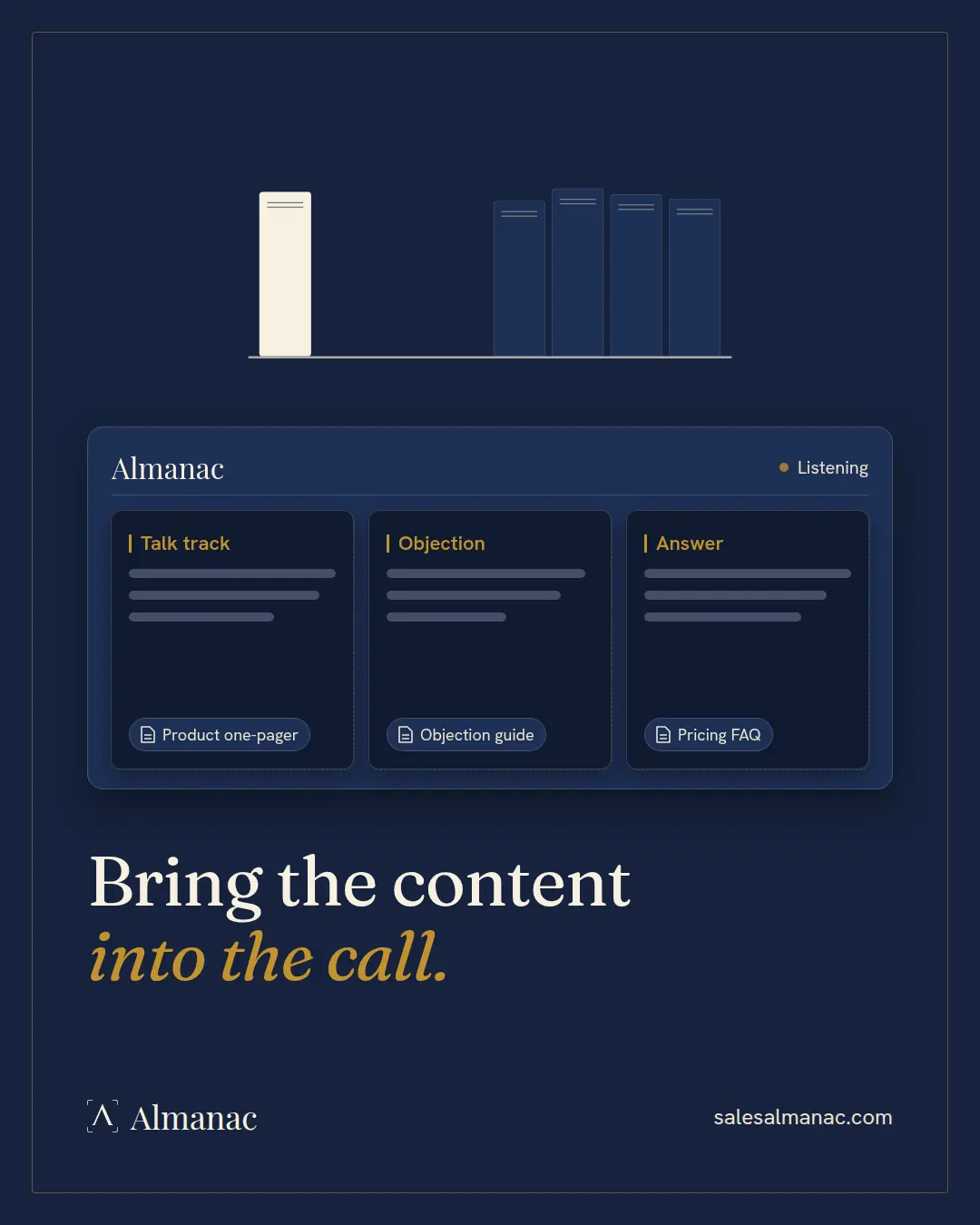
Around the call, Almanac builds a brief before the rep joins, and writes a scored debrief and a drafted follow-up email after they hang up. For practice, its Trainer lets reps rehearse with an AI buyer built from your personas and objection library, before a real buyer ever asks.
Frequently asked questions
What is sales enablement content?
Sales enablement content is any material that helps reps sell, from talk tracks and objection answers to case studies, battlecards and pricing guides. Some is shared with buyers. Some is for the rep’s eyes only.
What are examples of sales enablement content?
Common examples include talk tracks, call scripts, objection-handling guides, battlecards, product one-pagers, case studies, customer testimonials, demo scripts and pricing guides.
Why don’t sales reps use enablement content?
Usually because it isn’t reachable when they need it. Most content lives in drives and decks, and the moment of need is a live conversation where searching isn’t practical. Gartner found 77% of sellers struggle to complete their tasks efficiently despite enablement investment.
How do you keep sales messaging consistent?
Keep one source of truth, give each piece of content an owner, and deliver it from that single source rather than from files reps download. When an update reaches every rep at the same time, there is no old version left to drift from.