The Sales Onboarding Process: A 90-Day Plan That Puts Good Before Fast
A good sales onboarding process is not a crash course. The steps, a 90-day plan and checklist, and why practice and feedback matter more than speed.
A sales onboarding process is the plan that takes a new rep from their first day to confident, productive selling. A good one runs for about 90 days and follows a clear order: learn the buyer and the sales process, watch it done well, practice until it feels natural, then sell with a coach close by. The best programs are not crash courses. They build in regular practice, coaching and feedback, and they aim for good, not fast.
That last part is where most teams go wrong. They pack the first week with slides and product demos, hand over a territory, and hope. The research says hope is an expensive plan.
Two squares sized by area. A small navy square, 1x, stands for other teams. A square four times its size, 4x, stands for teams with the most effective onboarding, which are 4 times more likely to get new hires to productive selling in under 3 months. The squares then break apart into a grid of 100 dots, 35 of them gold: only 35 percent of respondents rate their company's sales onboarding as extremely or very effective.
What is a sales onboarding process, and what should it do?
Sales onboarding is how a company turns a new hire into a seller who can run a real conversation with a real buyer. Its job is not to transfer information. Its job is to build judgment: knowing what to ask, what to say and when to stop talking. Information is the easy part. Judgment takes practice and coaching, repeated over weeks.
Few teams think they have this right. In RAIN Group’s 2023 onboarding research, only 35% of respondents rated their company’s sales onboarding as extremely or very effective.
The gap matters. Organizations with the most effective onboarding were 4x more likely to get new hires to productive selling in under 3 months, and 6.3x more likely to prepare new hires to succeed. Turnover told the same story: average turnover was 50% at companies with the least effective onboarding, against 12% at the most effective.
Onboarding, in other words, is not an HR formality. It decides whether a hire becomes a seller or a vacancy.
Why the best onboarding is not a crash course
The pressure to move fast is real. Every week a new rep is not selling feels like lost revenue. So teams shorten the program and push people into the field.
Forrester’s research points the other way. In a 2024 analysis, principal analyst Peter Ostrow wrote that “focusing on good, not fast, is best for most sales onboarding.” Only 7% of companies put new hires in front of buyers on day one. The other 93% hold off, and Forrester argues the long-term cost of a rushed start outweighs a week or two saved. Forrester also found that winning sales reps and teams ran onboarding cadences about one-third longer.
A block of 100 dots, one for each of 100 companies. Seven gold dots have stepped out toward a circle marked buyers: 7 percent of companies put new hires in front of buyers on their first day. The seven then step back and all 100 dots stretch into one long line, a practice path, under Forrester's advice for sales onboarding: good, not fast.
Source: Forrester, How Quickly Should A Sales Rep Be Onboarded? (Peter Ostrow, 2024)
RAIN Group saw the same pattern from the other side. Organizations with less effective onboarding were significantly more likely to onboard for less than a month.
The irony is that patience is often the quicker route. Korn Ferry research found that companies with a strong onboarding program got sellers to full productivity in 8.5 months, against 9.5 months for those without one. Our guide on how long it takes to ramp a sales rep covers the benchmarks and what each month costs.
A rushed start does not save time. It moves the learning onto live calls, where mistakes cost deals.
How do you onboard a new sales rep, step by step?
Onboard a new sales rep in six steps, in this order: prepare before day one, teach the sales process, teach the buyer, let them watch, make them practice, then coach them on live calls. Each step should end with something the rep can show, not just something they attended.
- Prepare before day one. Accounts, tools and a written 90-day plan should be ready. Assign a manager for coaching and an experienced peer as a mentor. RAIN found 68% of the most effective programs use a mentor.
- Teach the sales process and methodology. RAIN calls strong training here the number one driver of effective onboarding, and says it is often missing. Reps need to know how your team sells, not only what it sells.
- Teach the buyer before the product. Who buys, what keeps them up at night, which objections come up and how your best people answer them. Product detail sticks better once it has a buyer attached.
- Let them watch. Shadowing good calls shows what the playbook sounds like out loud. Pair it with a short pre-call research routine so the rep learns the habit with the skill.
- Make them practice. Role plays with realistic buyers, real objections and honest scoring. This is where confidence is built, and where most programs are thinnest.
- Coach on live calls, then graduate on evidence. Early calls should come with support close by and a debrief after every one. A rep graduates when they can run a call well, not when the calendar says so.
What a 90-day sales onboarding plan looks like
A 90-day sales onboarding plan breaks the steps above into three phases, each with a clear finish line. The exact timing depends on your sales cycle. The order does not.
A timeline in three phases. Days 1 to 30: learn the buyer, the product and the sales process, and shadow good calls; practice with daily short role plays, then practice calls scored by a manager; done when the rep can explain your value in two minutes, prepare a call and handle the top five objections. Days 31 to 60: first live calls, with support; weekly role plays on real deals; done when the rep can run a discovery call with light coaching. Days 61 to 90: a full pipeline with less support; practice before key calls; done when the rep can run calls alone and self-review afterward.
Source: Almanac, drawing on RAIN Group and Forrester onboarding research
Use each “done when” line as your sales onboarding checklist. A rep who cannot do it is not ready for the next phase, no matter what week it is.
The missing piece is practice and feedback, not more content
When onboarding fails, it is rarely for lack of material. Most teams have plenty of decks. What they lack is time for a new rep to try things, get it wrong in private and hear what to fix.
The best programs make that time on purpose. RAIN Group found that among organizations with the most effective onboarding, 82% coach new hires on a regular schedule, 67% give regular feedback and 66% use simulations and role plays.
Newer reps say they are not getting it. In Salesforce’s 2026 State of Sales report, 46% of Gen Z sellers said they rarely get feedback on their sales conversations, and 47% said they don’t get enough roleplay before customer calls. They named a lack of manager time as the biggest obstacle.
Structure helps more than good intentions. Korn Ferry found that 62.9% of organizations still leave coaching to each manager’s discretion. The minority with a dynamic approach, tied to training and content, won 55.2% of forecast deals, against 41.8% for those that left coaching up to the individual manager.
The lesson is simple. Put practice and feedback on the calendar, from week one, and keep them there. Coaching that happens during the call itself helps too, because it reaches the rep at the moment the lesson matters.
Where Almanac fits
We built Almanac to make practice and coaching easier to fit into a busy team. Its Trainer lets a new rep practice against an AI buyer built from your personas and objection library, as often as they like, without waiting for a manager’s free hour. On real calls, Almanac puts answers from your team’s playbook on the rep’s screen, visible only to the rep, so a new hire is never stuck when a buyer asks something they don’t know the answer to.
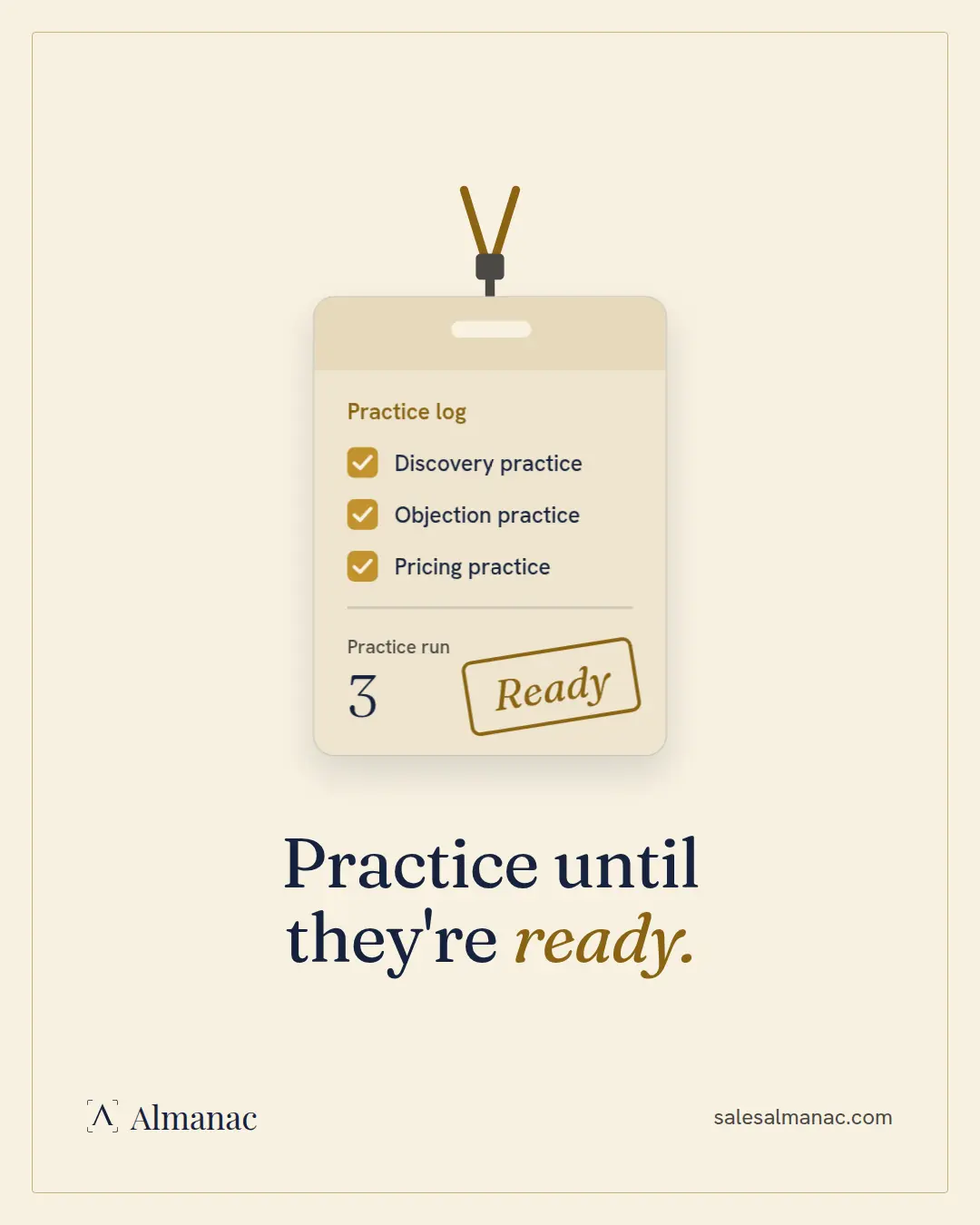
After each call, the rep gets a scored debrief and a drafted follow-up email. The playbook is built from the PDFs, docs and pages you already have, and an update reaches every rep on their next call. That means new hires learn the current version of how your team sells.
Frequently asked questions
What is sales onboarding?
Sales onboarding is the structured process that takes a new sales hire from their first day to running productive buyer conversations on their own. It covers the buyer, the product and the sales process, plus practice, coaching and feedback. Most good programs run for about 90 days.
How long should sales onboarding take?
Most structured programs run about 90 days, with practice and coaching continuing after that. Forrester advises “good, not fast,” and RAIN Group found that less effective programs were significantly more likely to last under a month. Full productivity takes longer, so plan for coaching to continue well past day 90.
What should be on a sales rep onboarding checklist?
Tools and accounts ready before day one, a manager and a mentor assigned, training on the sales process and the buyer, shadowed calls, scored role plays, and supported first calls with a debrief after each. Each item should end in something the rep can demonstrate.
How do you know if sales onboarding is working?
Watch what new reps can do, not what they have attended. Can they explain your value in two minutes, handle the common objections and run a discovery call with light coaching? Track feedback and practice too: if new hires rarely get either, the program is not working yet.