Sales to Customer Success Handoff: The Story Starts on the Call
Most handoff documents have gaps. What a good sales to customer success handoff holds, why it breaks, and how to capture it during the call.
A good sales to customer success handoff passes on the customer’s story, not just the contract. Customer success needs to know why the customer bought, who decides, what the rep promised and what could go wrong. Most teams fall short here. In Rocketlane’s State of Customer Onboarding Report 2024, a survey of more than 850 professionals, 77.1% rated their handoff documents as likely to have information gaps.
Those gaps rarely start in the handoff meeting. They start weeks earlier, on sales calls, when the buyer said something important and nobody wrote it down. That is why the fix sits where real-time sales coaching does: on the call itself.
Bars for each answer from 0 to 5. First they stack into two columns: answers 0 to 2, and a taller gold column for answers 3 to 5, labeled 77.1 percent, rating gaps likely. Then the bars spread out along the scale at their real heights, and the tallest group sits at the likely end, with 24.6 percent answering 5, highly likely.
Source: Rocketlane, State of Customer Onboarding Report 2024. Survey of 850+ professionals
What is a sales to customer success handoff?
A sales to customer success handoff is the moment a closed deal passes from the account executive to the team that will onboard and keep the customer. It usually takes the form of a document, a meeting, or both. Its job is simple: the customer should never have to tell their story twice.
That is harder than it sounds. The account executive has spent weeks, sometimes months, with the buyer. They know which goal got the budget approved and which manager was nervous. They know the feature the buyer was promised by a date. Customer success knows none of it unless someone writes it down.
Much of this sits in the space between the end of a deal and the start of a relationship, which is why it falls through. The rep is already chasing the next quarter. Customer success is meeting a stranger.
Why do sales handoffs break down?
Sales handoffs break down because the most useful details live in conversations, not in fields. A CRM can hold the contract value and the close date. It rarely holds the sentence the buyer said in week three about what success would look like for them.
There is also the size of the room. Forrester’s State of Business Buying, 2024 found that on average, 13 people within an organization are involved in the buying decision, with 89% of purchases involving two or more departments. Each of those people had their own reason to say yes. A handoff that names one champion leaves most of them out.
And customers feel it. Salesforce reports that 55% of customers say it generally feels like they are communicating with separate departments, rather than one company. The first onboarding call that asks “So, what are your goals?” is exactly that feeling.
The customer should never have to tell their story twice.
What should a sales handoff include?
A useful sales handoff includes five things, each one something the buyer said out loud during the sale. Keep it to a page. If customer success cannot read it in five minutes before the kickoff call, it is too long.
- The goal, in the buyer’s words. Not “improve efficiency.” The actual outcome they named, and the number they hoped to move.
- The people. Who signed, who uses it, who has doubts, and who was quiet. Our guide to stakeholder mapping in sales covers how to find them.
- What was promised. Every commitment, deadline and “yes, we can do that.” It is also the easiest line to forget.
- The risks. The objection that never fully went away. The competitor they almost chose. The internal project fighting for the same people.
- The next step and its date. What the customer expects to happen first, and when.
This is the core of any sales to customer success handoff template. The headings are easy to copy. The hard part is filling them in with real words instead of guesses.
Why does the handoff matter so much for renewals?
The handoff matters because it sets the tone for everything after the signature. Forrester’s same 2024 research found that 81% of buyers express dissatisfaction with their chosen providers. A deal can close with doubts still open, and a cold handoff gives those doubts room to grow.
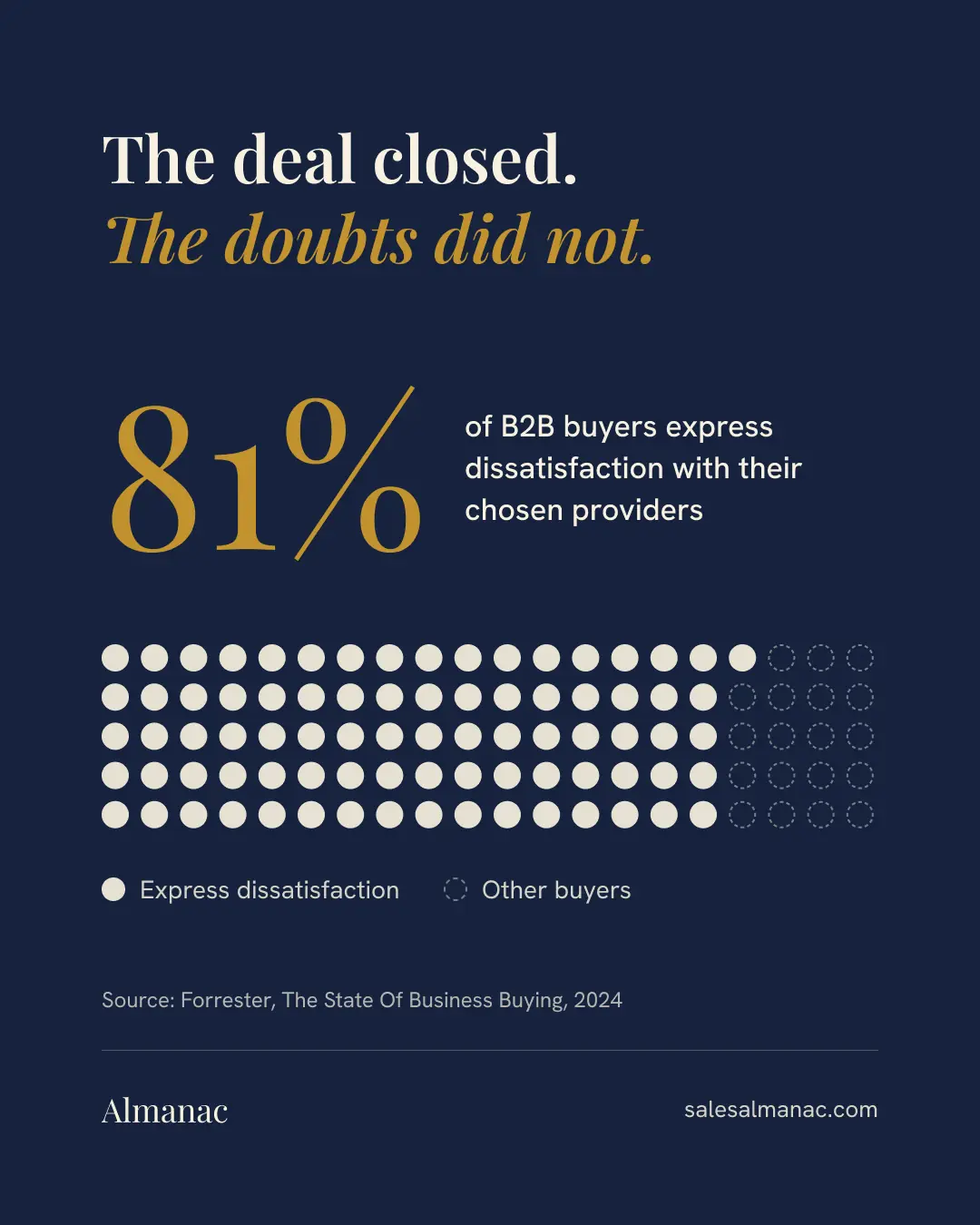
Getting it right pays off later. In HubSpot’s 2025 State of Sales report, a survey of 1,000 global sales pros, understanding customer goals (42%) ranked among the top drivers of upsells. Those goals were usually stated during the sale. If they did not survive the handoff, customer success has to discover them again, and the customer notices.
This is also why the handoff is a sales skill, not an admin task. The rep who listens well on the call, and captures what they hear, gives the customer a better start.
How do you capture the story while it is still fresh?
You capture it during the call, not the night before the handoff meeting. Notes written days later lose the exact words, and the exact words are what customer success needs. Three habits help.
Two columns, Said on the call and In the handoff, with five slots: their goal, who decides, what we promised, the risks and the next step. First only two items, who decides and the next step, sit in the handoff, and three slots are empty; the rest stay with the rep. Then all five slide into the handoff and turn gold: captured during the call, the whole story reaches customer success.
Almanac illustration
- Ask the handoff questions early. “What would make this a clear win six months from now?” and “Who else will judge whether it worked?” belong in discovery, not at the end. Our checklist on what to research before a sales call helps you arrive ready to ask them.
- Write promises down the moment you make them. If you say “yes, that integration will be ready by March,” it goes into the record that day. Memory is generous to the person who made the promise.
- Hand off in the customer’s words. Quote the buyer where you can. “They said onboarding has to be done before their busy season in April” beats “timeline concerns.”
A good sales handoff process also includes a short meeting with customer success before the customer meets them. Ten minutes is enough if the document is good. The point is a warm introduction, so the customer hears “I already know about your April deadline” on day one. Buyers notice when you remember. As our look at B2B buyer behavior found, buyers have little patience for calls that waste their time.
Where Almanac fits
Almanac is built to keep the story from getting lost. During the call, it puts answers and the next question from your team’s playbook on the rep’s screen, visible only to the rep, so the questions that matter for the handoff actually get asked. After the call, Almanac writes a scored debrief, drafts the follow-up email and prepares handoff docs.
Before the next call, the brief shows what is already captured, what is still missing, and who in the room already has the story. That makes the handoff the last step of a well-kept record, not a scramble at the end.
Frequently asked questions
What is the difference between a sales handoff and customer onboarding?
The sales handoff is the transfer of knowledge from the account executive to customer success. Onboarding is the work that follows with the customer. A good handoff makes onboarding faster, because the customer success team starts with the customer’s goals, people and promises already in hand.
Who owns the sales to CS handoff?
The account executive owns the content, because they were on the calls. Customer success owns reading it and asking follow-up questions before the kickoff. Many teams also give a sales manager the job of checking that the handoff is complete before a deal is marked closed.
When should the handoff happen?
Plan it before the deal closes. Introduce customer success during late-stage calls where it makes sense, and finish the handoff document within a day or two of signature, while the details are fresh.
How common are gaps in handoff documents?
Very common. In Rocketlane’s 2024 survey, 77.1% of professionals rated their handoff documents as likely to have information gaps, and 24.6% rated gaps highly likely. The fix is to capture goals, people, promises and risks during the sale, not after it.