How to Handle Price Objections in Sales: Trade, Don't Cave
Most buyers expect to trade on price. How to handle price objections in sales: find what the objection means, restate the value, and trade instead of cave.
To handle price objections in sales, slow down before you answer. Find out what the objection really means, restate the value in the buyer’s own words, and if the price has to move, ask for something in return. Do not open with a discount.
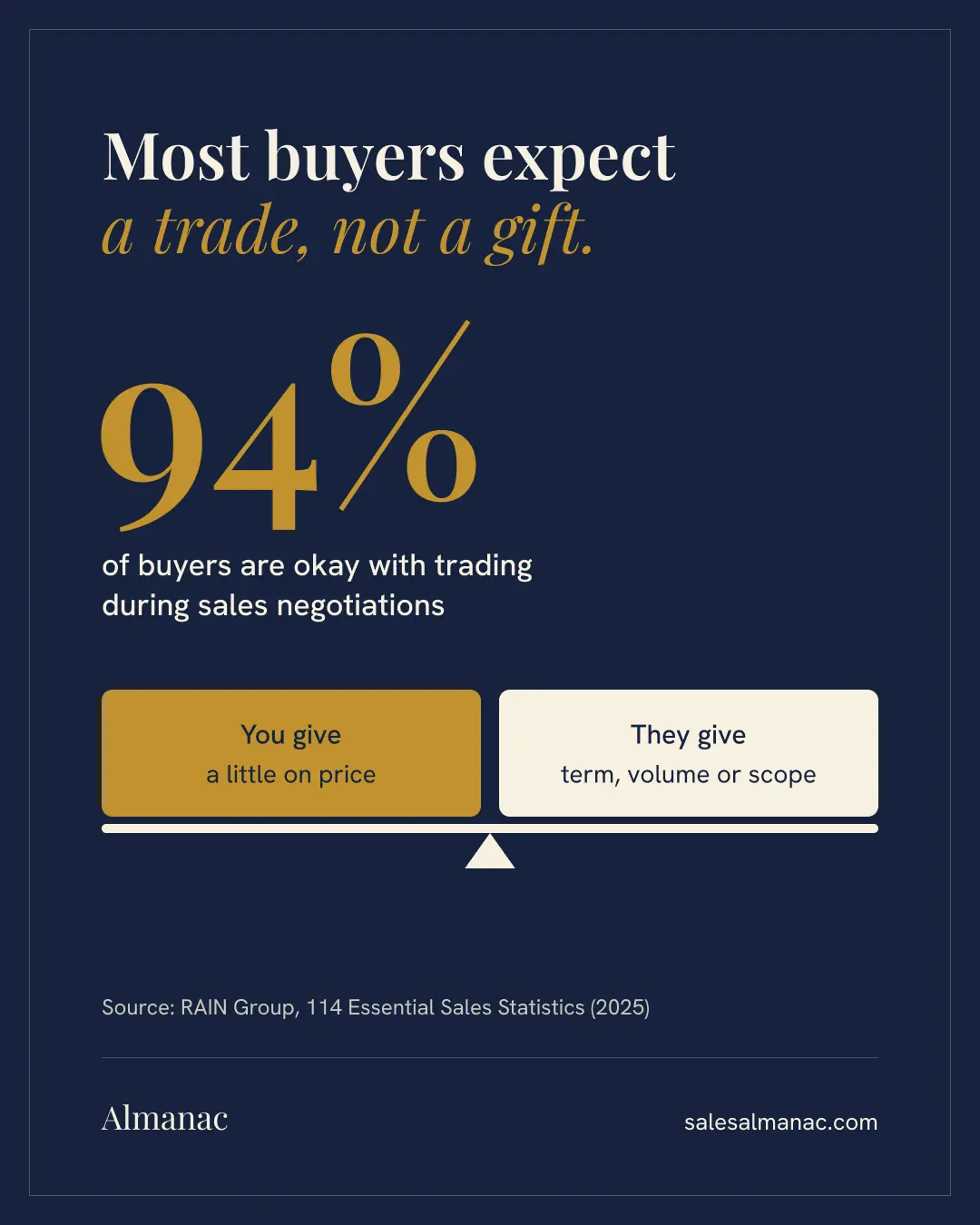
Buyers expect this. In RAIN Group’s sales research, 94% of buyers say they are okay with trading during sales negotiations. A trade keeps your price meaningful. A cave teaches the buyer that pushing works.
A bar labeled buyers in sales negotiations is 94 percent gold: 94 percent of buyers are okay with trading. The gold bar then splits into two blocks that settle on a level scale. On one side, you give a little on price. On the other, they give something back, such as a longer term, more volume or a smaller scope.
Source: RAIN Group, 114 sales statistics, updated July 24, 2025
What is a price objection, really?
A price objection is any moment when a buyer points to cost as the reason not to move forward. “It’s too expensive.” “We don’t have the budget.” “Your competitor is cheaper.” The words are about money. The problem underneath often is not.
Price does matter. Forrester’s State of Business Buying 2023 found that at least a third of B2B buyers in North America and Europe are primarily influenced by price when they make purchasing decisions. For those buyers, the number is the decision.
For many others, “too expensive” is shorthand. It can mean the budget is gone for the year. It can mean they doubt it will work. It can mean they cannot explain the cost to their boss. Each of those needs a different answer, and none of them is fixed by a lower number alone.
This is why the moment itself matters so much. A price objection happens live, mid-call, with the buyer watching how you react. It is one of the clearest cases for real-time sales coaching: the right response is needed now, not in next week’s review.
A speech bubble reads: it's too expensive. It then breaks into four chips, the different problems the same words can mean: there is no budget this year, they are not sure it will work, they are comparing a cheaper option, or they cannot justify it internally.
Almanac, the four meanings discussed in this article
Why does discounting first backfire?
Discounting first backfires because it answers a question the buyer may not have asked. If the real problem is doubt, a cheaper price does not remove the doubt. It just makes the doubt cheaper.
RAIN Group’s negotiation research, which studied 713 buyers and sellers, put it bluntly: “Most sellers cave and give into pure price concessions, but most buyers admit to being able to pay.” The sellers who do best behave differently. RAIN Group found top performers are 46% more likely to trade for value rather than cave, and 3.1 times more likely to achieve target pricing.
A quick discount also does not buy a happy customer. Forrester’s 2024 research found that 81% of buyers express dissatisfaction with the provider they choose at the end of a “successful” purchase. Price is the reason cited most often. Winning the deal on price does not end the conversation about price.
A discount answers the question the buyer asked. A good question answers the one they meant.
What is the best way to handle a price objection on a call?
The best way to handle a price objection is a short, calm sequence: acknowledge, ask, restate value, then trade if you must. It takes a minute. It works on a first call and in a final negotiation.
- Acknowledge it plainly. “That’s a fair thing to raise.” Do not argue, rush or apologize. A pause tells the buyer you take the concern seriously.
- Ask what it means. “Too expensive compared to what?” or “Is it the total, or the timing?” The answer tells you which problem you are actually solving.
- Restate the value in their words. Go back to what they told you in discovery: the cost of the problem, the goal, the deadline. Use their numbers, not your brochure.
- If the price moves, trade. Ask for something back. A longer term, a larger volume, a smaller first phase, a faster signature or a reference call are all fair trades.
- Confirm it in writing. Recap what changed and what each side agreed to, so the trade does not quietly turn into a discount later.
Step three is where most of the work is. Among the factors a seller controls, RAIN Group found focusing on value was cited by 96% of buyers as an influence on their purchase decision. Value only lands if it is specific. That depends on what you learned before the call, so the checklist on what to research before a sales call does double duty here.
What should you say when a buyer says “it’s too expensive”?
Say less than you think. Short, honest questions work better than long defenses. A few lines that hold up in most calls:
- “Too expensive compared to what you’re doing today, or compared to another option?”
- “If price weren’t a factor, would this be the right fit?”
- “What would need to be true for this to be an easy yes?”
- “If we adjusted the price, could you commit to a two-year term?”
The second question is the most useful. If the answer is no, price was never the real issue, and you have just learned what is. If the answer is yes, you are now negotiating the shape of the deal, not the worth of the product.
Sometimes you will not know the answer to a follow-up, like a detailed cost comparison or a contract term. Do not guess. Say you will confirm it and when. This guide on what to do when you don’t know the answer covers the exact phrasing.
How do sales managers prepare a team for price objections?
Managers prepare a team for price objections the same way athletes prepare for a hard play: shared answers, then practice, then review. Handling price objections well is a skill, and skills come from repetition.
- Write the answers down once. Agree on the team’s position for the most common price objections: what you will trade, what you will not, and the questions to ask first.
- Practice before the real call. Role-play the hard version, the buyer who repeats “too expensive” three times. The first time a rep hears it should not be with a real deal on the line.
- Review what happened. After calls where price came up, look at the order of moves. Did the rep ask before answering? Did a discount come with a trade?
This matters because buyers are judging more than the price tag. As Gartner’s Daniel Hawkyard put it in a 2025 release, “Customers are not just buying a product; they are buying the promise of value realization.” A rep who holds the price calmly, and explains why, is selling that promise.
Where Almanac fits
Almanac helps reps handle price objections in the moment, and practice them before it counts. Your playbook, built from your own documents, holds the team’s agreed answers. During the call, Almanac puts the answer and the next question on the rep’s screen, visible only to them.
Before that, reps can rehearse in Trainer, a role-play against a live AI buyer built from your personas and objection library. After the call, a scored debrief shows how the moment went. When pricing guidance changes, update the playbook once and every rep has it on their next call.
Frequently asked questions
What is the best way to handle a price objection?
Acknowledge it, ask what it means, restate the value in the buyer’s own words, and only then discuss price. If the price moves, ask for something in return, such as a longer term or larger volume. RAIN Group found 94% of buyers are okay with trading during sales negotiations.
Should you ever offer a discount?
Yes, but as a trade, not a reflex. A discount given in exchange for something of value to you, like a multi-year commitment, keeps your price credible. A discount given just because the buyer pushed teaches them to push again.
Why do buyers say “it’s too expensive” when price isn’t the issue?
It is a short, safe way to say no without explaining. The real reason may be budget timing, doubt that the product will work, or difficulty justifying the cost internally. Asking “compared to what?” usually brings the real reason out.
How can reps practice handling price objections?
Role-play the toughest version of the objection with a manager or peer, using the team’s agreed answers. Then review real calls where price came up and check the order of moves: question first, value second, trade last.