The Follow-Up Email After a Sales Call: Write It From What They Said
A strong follow-up email after a sales call is specific, sent the same day and ends with one dated next step. What to include, when to send it, templates.
The best follow-up email after a sales call is short, sent the same day, and built from what the buyer actually said. It plays back their problem in their words. It delivers what you promised. It answers the question you could not answer live. And it ends with one next step that has a date on it. That is the whole job.
The usual version does the opposite. “Just checking in” and “let me know if you have any questions” could be sent to anyone, and buyers read them that way. Research from the RAIN Group Center for Sales Research found that content 100% customized to a buyer’s specific situation influences 67% of buyers to accept a meeting with a seller. That finding is about earning the meeting. The same logic carries into the email that comes after it.
A draft email reads: Subject, following up. Hi first name, just checking in on company. Any questions about product? Let me know your thoughts. Below it, 67 percent of buyers are influenced to accept a meeting by content customized to their specific situation. The draft then rewrites itself from the call: Subject, the SOC 2 report you asked for. Hi Maya, here is the SOC 2 report you asked for. On onboarding, a short plan is attached. Next step: Thursday, with your IT lead.
Source: RAIN Group Center for Sales Research, Top Performance in Sales Prospecting. Share rating it very or extremely influential in accepting a meeting. Email is illustrative
A follow-up is not a reminder. It is the record of the call.
Reps tend to treat the follow-up as a nudge, a way to stay on the buyer’s radar. Buyers use it differently. It is the note they forward to their boss, paste into an internal thread, or reread before the next meeting. Often it is the only part of the conversation that reaches the people who were not there.
That changes what the email is for. A reminder only has to exist. A record has to be right. If it gets the buyer’s problem wrong, or leaves out the thing they cared about most, it quietly tells them you were not listening.
This is why the follow-up belongs to the call itself, not to the admin pile after it. Good real-time sales coaching treats the call as one piece of work: the preparation, the conversation and what you send when it ends. And because the email travels, write it for the readers you have not met yet. Our guide to stakeholder mapping covers how to find them.
What should a follow-up email after a sales call include?
A strong follow-up email after a sales call includes five things, in this order. Most good ones fit on a phone screen without scrolling.
- A subject line about them. Name the thing they asked for or the problem they raised. “The SOC 2 report you asked for” gets opened. “Following up” gets filed.
- Their problem, in their words. One or two sentences that play back what they told you. If they said “our reps lose Fridays to fixing the CRM,” write that, not “improving data hygiene.”
- What you promised. The deck, the case study, the security document. Attach it or link it. Do not make them ask twice.
- The answer you owed them. If a question stumped you on the call, give the answer, or say who is getting it and when. Our piece on what to do when you don’t know the answer covers that moment live.
- One next step with a date. Not “let me know your thoughts.” A specific meeting, with specific people, on a specific day.
Notice what is missing: a recap of your pitch. The buyer heard it. What they need now is proof that you heard them.
Send it the same day, while the call is still fresh
Send the recap the same day, ideally within a few hours of hanging up. There is no magic number here. The reason is memory. Right after the call, you still have the buyer’s exact phrases. They still remember why they took the meeting. By the next morning, both have started to blur.
Speed is not a reason to be vague, though. A specific email in the afternoon beats a generic one sent a minute after the call.
The recap is also only the first email. After it, each follow-up should have a job of its own.
A timeline of three follow-ups. Same day: the recap, covering what they said, what you promised and one next step with a date. Before the next meeting: the confirmation, with time, agenda and who is joining. If it goes quiet: something new, such as an answer, an example or an idea that fits their problem.
Source: Almanac editorial guidance
Three follow-up email templates to start from
These are illustrative starting points, not scripts. The brackets mark what only the call can fill in. If you cannot fill a bracket from your notes, the email is not ready yet.
The same-day recap
Subject: [The thing they asked for]
Hi [Name],
Thanks for the time today. You said [their problem, in their words], and that [what it costs them if nothing changes].
As promised, here is [the item you promised]. On [the question you couldn't answer], I checked with [colleague]: [the answer, or when they will have it].
Next step: [the meeting] on [day] with [the person they mentioned]. Does [time] work?
[Your name]
The answer you owed them
Subject: Your question about [topic]
Hi [Name],
On our call you asked [their exact question]. The short answer: [one sentence].
The detail is here: [link or attachment]. If it would help, [colleague] can join [the next meeting] to go deeper.
[Your name]
When it goes quiet
Subject: [Something new] for [their problem]
Hi [Name],
When we spoke, you mentioned [their priority]. I came across [one specific, relevant thing] and thought of you.
If [their priority] is still on the list for [the timeframe they gave], is [day] a good time for [the next step]?
[Your name]
Generic follow-ups fail because they hand the buyer the work
“Just checking in” asks the buyer to remember the call, decide what mattered, and work out what happens next. That is three jobs, handed to the busiest person in the deal. Most will not do them.
A specific email does that work for them. It shows you listened. It gives them something they can forward without editing. And it makes the next step easy to accept.
A follow-up that could be sent to anyone tells the buyer they could be anyone.
The hard part is rarely the writing. It is the remembering. Most weak follow-ups do not come from lazy reps. They come from reps who took thin notes on a busy day and are now rebuilding an hour of conversation from memory. Fix what you capture during the call, and the email mostly writes itself. The same discipline starts before the call, with knowing what to research, so you notice the details worth playing back.
Where Almanac fits
Almanac drafts the follow-up from the call itself. After each call, it produces a scored debrief, a drafted follow-up email and handoff docs, all built from what was actually said. The rep starts from the buyer’s own words instead of a blank page, then reads, edits and sends.
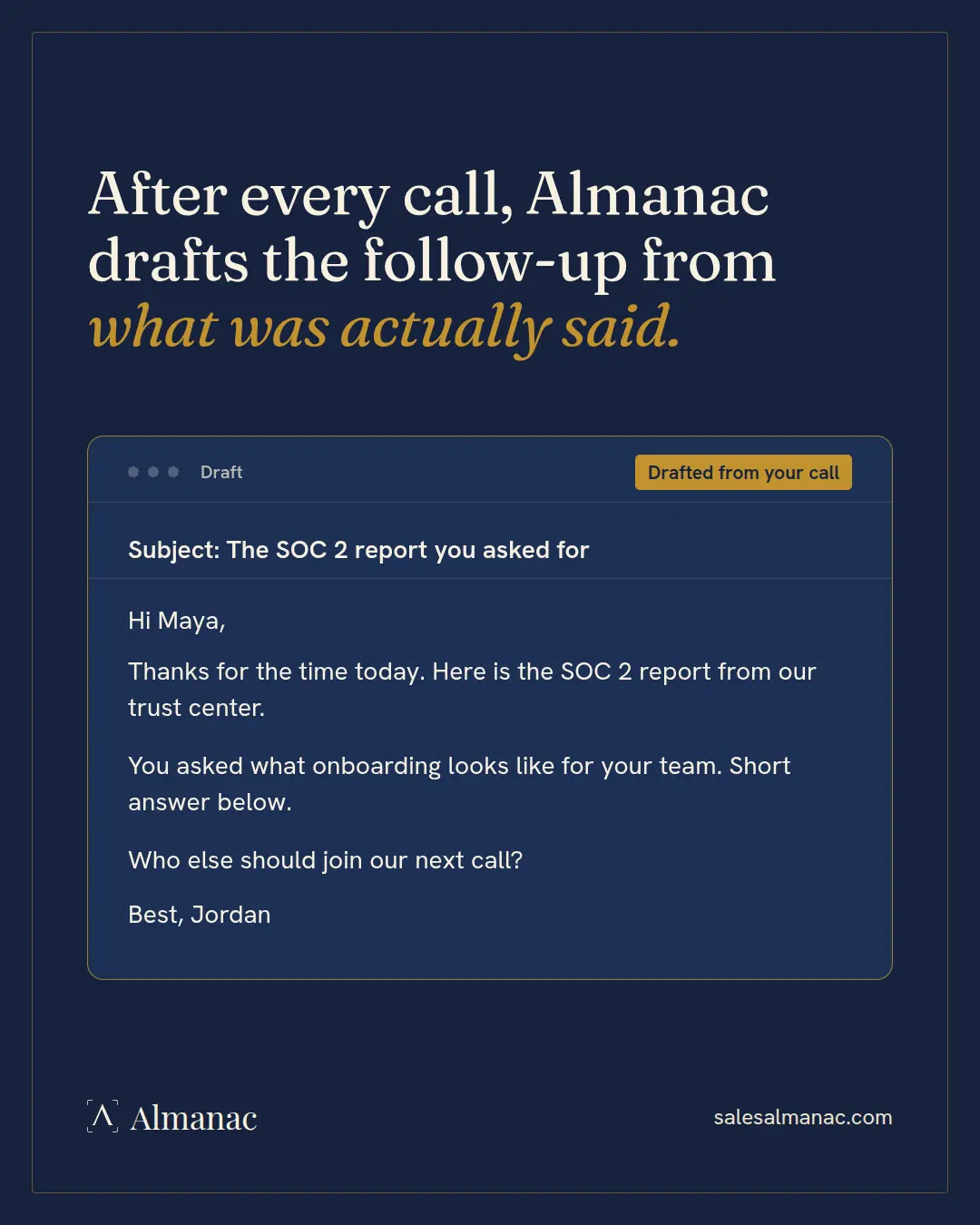
It helps earlier, too. During the call, answers and the next question from your team’s playbook appear on the rep’s screen, visible only to them, so fewer questions are left open for the email to chase.
Frequently asked questions
How soon should you send a follow-up email after a sales call?
The same day, ideally within a few hours, while both sides still remember the details. A specific email sent later in the day is better than a generic one sent the moment you hang up.
How long should a sales follow-up email be?
Short enough to read on a phone without scrolling: a clear subject line, a few short paragraphs and one next step. If it runs longer, the extra material probably belongs in an attachment.
What should the subject line of a follow-up email say?
Name the thing the buyer asked for or the problem they raised, such as “The SOC 2 report you asked for.” Avoid “Following up” or “Checking in,” which tell the buyer nothing about why to open it.
How many times should you follow up after a sales call?
There is no reliable magic number. Follow up when you have something useful to send: the recap, an answer you owed, the agenda for the next meeting, or a new idea that fits their problem. Each email should give the buyer a fresh reason to reply.