Why Is Sales So Hard Right Now? The Job Got Harder, Not You
Why is sales so hard? 54% of sellers say it got harder, and new AEs now take a record 6.2 months to ramp. What changed, and what still works.
Sales is so hard right now because the conditions around every conversation have changed. Budgets are tighter, buyers do their homework before they ever talk to you, more people sign off on each deal, and deals take longer to close. In HubSpot’s 2024 Sales Trends Report, 54% of sales pros said selling had been harder than it was before. They named inflation, stiff competition, a lack of high-quality leads, trouble reaching decision-makers and longer deal cycles.
If the job feels heavier than it did a few years ago, that is not a story you are telling yourself. It is in the data.
A ring of 50 blocks, 27 of them gold: 54 percent of sales pros say selling has been harder this year than it was before. The gold blocks then stack into five bands, one for each reason they gave, most cited first: inflation, standing out from the competition, a lack of high-quality leads, reaching decision-makers, and longer deal cycles.
Source: HubSpot, 2024 Sales Trends Report. Survey of 1,400+ sales professionals, August 2023
It is not just you. More than half of sellers feel it.
HubSpot surveyed more than 1,400 sales professionals in August 2023. Most were still meeting or exceeding their goals, but it took more work to get there. Over half said selling had become harder, and the reasons they gave were mostly outside any one rep’s control.
Money was the first of them. In the same report, 70% of sales pros said budgets were more scrutinized than the year before, and 62% said their company was taking fewer risks. A buyer who has to defend every dollar asks more questions, brings in more people and waits longer to say yes.
Hard is not the same as hopeless, though. A harder market rewards different habits, and most of them can be learned. Our guide to real-time sales coaching covers the ones that happen during the call itself.
Buyers show up later, and with more people
The second change is who you are talking to, and when. HubSpot found that 96% of prospects do their own research before talking to a sales rep, and 71% would rather do their own research than talk to a person at all.
So by the time a buyer agrees to a meeting, they have already formed a view. The easy questions are answered. What is left are the hard ones: how this works for their team, what it really costs, what could go wrong. A rep who repeats the website loses the room in minutes.
There are also more people in that room. HubSpot puts the average number of decision-makers in a sale at five. Each one has a different worry, and any one of them can slow the deal down. Some never do. They just stop replying. That is why mapping the buying committee early is no longer optional on bigger deals.
Time is the final cost. In the same survey, 28% of sales pros said a sales process that takes too long is the biggest reason prospects back out of deals. Longer cycles are not just slower. They give a deal more chances to die.
The numbers say the job itself changed
If the market were the only problem, you would expect it to show up in mood surveys and nowhere else. It shows up in the hard benchmarks too.
The Bridge Group’s 2026 study of account executives, drawn from 158 B2B companies, found that 48% of AEs hit quota, down from 51% in 2024. The time it takes a new AE to reach full productivity is now 6.2 months, the highest in the study’s history. The firm ties that to growing deal complexity and bigger buying committees.
The front of the funnel moved the other way. In The Bridge Group’s 2025 SDR study of 351 B2B companies, average SDR ramp fell to 3.0 months, the lowest since 2010. Getting a new SDR up to speed got faster. Getting a new AE there got slower.
Two 12-month dials. SDR ramp fills 3.0 months, the lowest since 2010. AE ramp fills 6.2 months, the highest on record. Each dial then unrolls into a January to December row: an SDR who starts on January 1 is at full speed in April, an AE who starts the same day is at full speed in early July.
Source: The Bridge Group, SDR (2025) and AE (2026) research. Surveys of 351 and 158 B2B companies
Picture two people hired on New Year’s Day. The SDR is at full speed by April. The AE is not there until early July. Half a year of learning a product, a market and a buying process, in a market where fewer than half of AEs hit their number. We put real numbers on what those months cost in our guide to how long it takes to ramp a sales rep.
Why sales feels so stressful
Sales is stressful because the result is public and the inputs are not fully yours. Your number is on a dashboard. The budget freeze, the new stakeholder and the competitor who cut their price are not. You carry the outcome of decisions you never got to make.
Then the number resets. A great quarter buys you a few weeks of relief before the count starts again at zero. Add a steady drip of rejection, and it is easy to read a hard market as a personal failing.
A harder market is not a verdict on you. It is a change in the work, and work can be learned.
The reps who last tend to separate the two. They take the result seriously and the rejection less personally. They judge their week by what they controlled: how well they prepared, how well they listened, how clearly they asked for the next step.
What still works when selling gets harder
None of this calls for working longer hours. It calls for spending the hours on fewer, better conversations. Four habits carry the most weight.
- Qualify earlier and more honestly. In a tight market, a deal with no budget and no urgency is not a slow deal. It is a lost one that has not ended yet. Ask about budget, timing and who signs in the first or second call, and walk away sooner.
- Reach more than one person. With five decision-makers on an average deal, a single champion is a single point of failure. Build a second and third relationship before you need them.
- Bring what the buyer cannot find alone. They have read the website. Bring a sharp question, a pattern you have seen at similar companies, or a straight answer about risk. That is the part of the call they cannot get from research.
- Get help in the moment, not a week later. The hardest moments in a call are the questions you did not expect. Knowing what to do when you don’t know the answer keeps the conversation moving instead of stalling it.
For managers, the same list applies with one addition: give newer reps practice before the call that matters, not feedback after it. A six-month ramp is a long time to learn only from live deals.
Where Almanac fits
We built Almanac for the moments that got harder. Before a call, it builds a brief that shows what is already known about the deal, what is still missing and who in the room already has the story. During the call, it puts answers and the next question from your team’s playbook on the rep’s screen, visible only to the rep. Afterward, it writes a scored debrief, drafts the follow-up email and prepares the handoff docs.
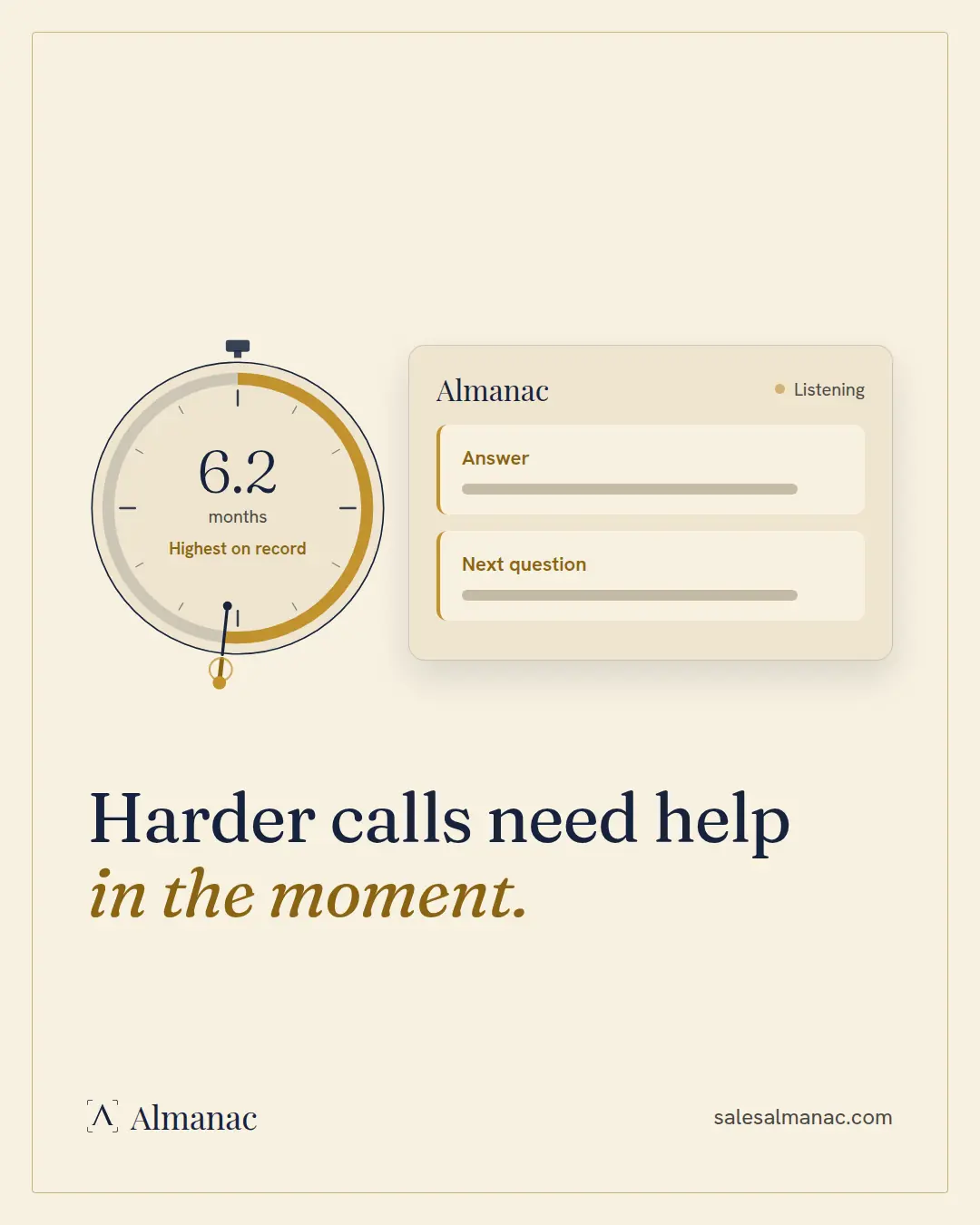
For ramp, the Trainer lets reps role-play against a live AI buyer built from your team’s personas and objection library. The playbook itself is built from the PDFs, Word docs and links you already have, and an update reaches every rep on their next call.
Frequently asked questions
Why is sales so hard?
Sales is hard because buyers are more cautious and better informed than they used to be. In HubSpot’s 2024 Sales Trends Report, 54% of sales pros said selling had become harder, citing inflation, competition, a lack of good leads, trouble reaching decision-makers and longer deal cycles.
Why is sales so stressful?
The result is public and measured every month or quarter, but many of the factors behind it, like budgets and buying committees, are outside the rep’s control. Frequent rejection and a target that resets each period add to it. Judging your week by the inputs you control helps.
Is sales harder now than it used to be?
By several measures, yes. The Bridge Group found 48% of AEs hit quota in its 2026 study, down from 51% in 2024, and new AEs now take 6.2 months to reach full productivity, the longest the study has recorded.
How long does it take to get good at sales?
The Bridge Group puts average ramp to full productivity at 3.0 months for SDRs and 6.2 months for AEs. Getting good beyond that takes longer, and it comes faster with regular practice and coaching close to real calls.