What Is Value Selling? What It Looks Like From the Buyer's Side
Value selling ties every part of a sale to an outcome the buyer cares about. What buyers count as value, why most meetings miss it, and how to fix that.
Value selling is a way of selling in which every part of the conversation is tied to an outcome the buyer cares about: revenue they could gain, cost they could cut, risk they could avoid or time they could win back. The product still matters, but it comes second. It is the means. The buyer’s result is the point.
That is the textbook answer to what value selling is. The buyer’s answer is shorter. Value selling is a seller who understands what we are trying to get done and makes the call worth our time. Buyers reward it. In RAIN Group’s research, 96% of buyers report that a seller’s focus on the value they can deliver is the most influential factor in their purchase decision.
A gauge of 100 ticks with the needle at 96: 96 percent of buyers say a seller's focus on the value they can deliver influences their purchase decision. The gauge then straightens into a bar at the top of a short ranking of what sellers control: focusing on value, 96 percent; collaborating with buyers, 93 percent; educating with new ideas, 92 percent.
Source: RAIN Group Center for Sales Research. Share of buyers who say each factor influences their purchase decision
Value is what the buyer can measure, not what you can list
Value, from the buyer’s side, is a change they can point to after the deal. A faster close of the books. Fewer support tickets. A team that stops working weekends. It is rarely a feature, and it is never a feature list.
This is the core difference between value selling and feature selling. Feature selling starts with the product and hopes the buyer connects it to a problem. Value selling starts with the problem and connects the product to it only where the link is real. You will also hear it called value based selling. The idea is the same.
The trouble is that value is specific. The same software saves one company money and saves another company a hire. A finance lead and an operations lead in the same meeting may want different things from it. You cannot know which value matters until you know the buyer, which is why value selling begins long before the call, with sales call preparation.
Focusing on value is not the only thing buyers reward. RAIN Group found that collaborating with buyers (93%) and educating them with new ideas (92%) also shape purchase decisions. All three have one thing in common. They are about the buyer’s situation, not the seller’s pitch.
Most meetings fail the buyer’s test
If buyers care this much about value, you might expect most sales meetings to deliver it. They do not. The same research found that buyers say 58% of their meetings with sellers don’t provide value.
A bar made of 50 meetings. 58 percent of it is pale: buyers say 58 percent of their meetings with sellers don't provide value. The bar then breaks apart into a buyer's Monday to Friday calendar, with the meetings that provide no value scattered between the useful ones.
Source: RAIN Group Center for Sales Research. Top Performance in Sales Prospecting study, 488 buyers
Think about what that means from the other side of the table. A buyer takes a meeting hoping to learn something. More often than not, they leave with a product tour they could have watched on the website and a request for another meeting.
Those meetings do not just fail on their own terms. They make the next meeting harder to get. Every empty hour teaches the buyer that sales calls are a cost to be managed.
Buyers decide whether you understand them before you speak
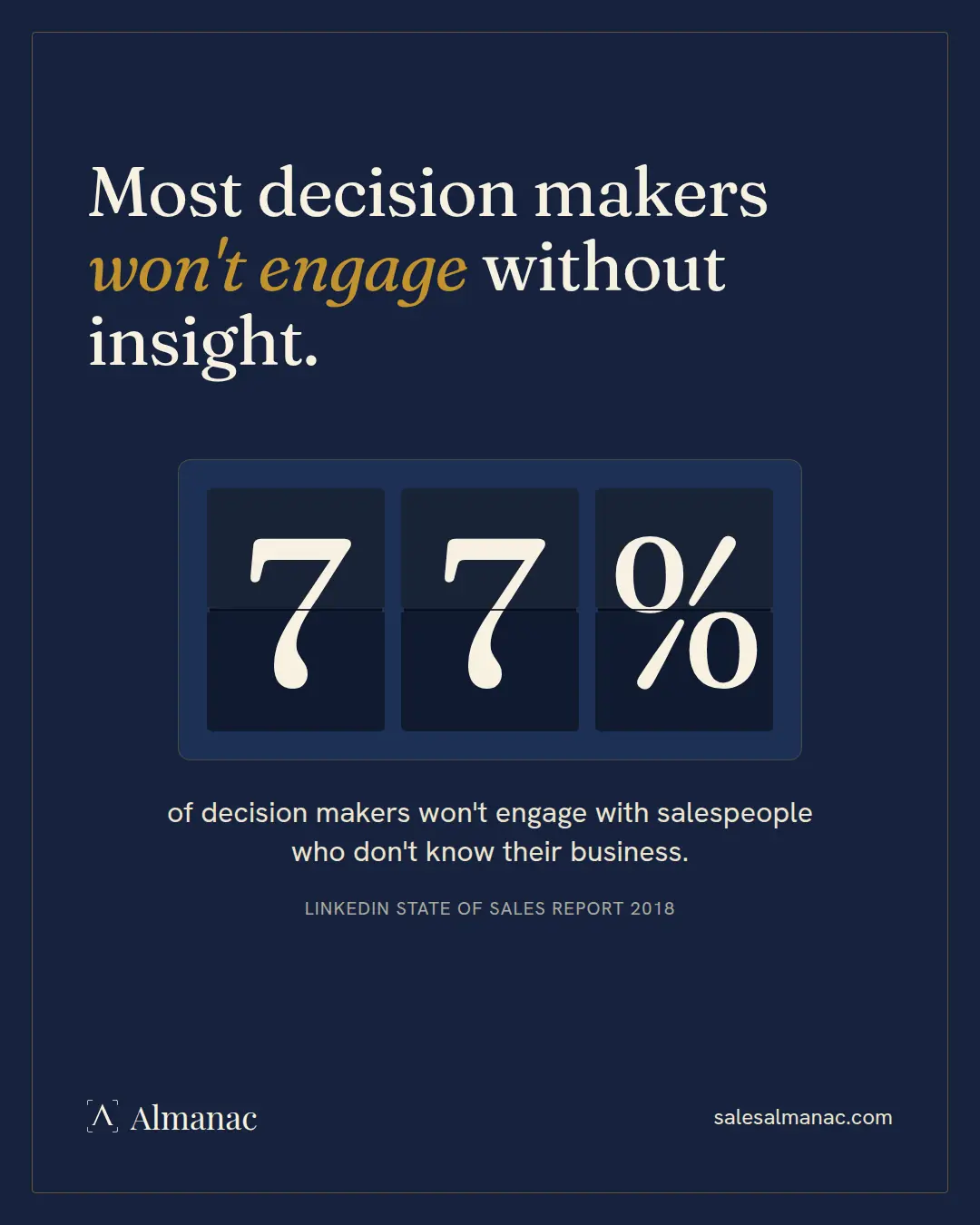
Most of the judgment happens early. A buyer decides in the first few minutes whether the seller has done the work. LinkedIn’s 2018 State of Sales report put it bluntly: 77% of decision makers won’t engage with salespeople who don’t have insights or knowledge of their business.
Knowledge of their business is the raw material of value. You cannot connect a product to an outcome you have not heard about. That means knowing the company’s priorities, what changed recently, who is in the room and what each of them is measured on. Our checklist on what to research before a sales call covers the ground.
Buyers do not pay for features. They pay for a better version of their own situation.
What value selling looks like on a real call
Value selling is less a script than a habit of attention. On a real call, it tends to look like this.
- Open with their world, not yours. Start with what you learned about their goals and ask whether it is still true. It shows the work and invites correction.
- Ask about the cost of standing still. What happens if nothing changes for a year? The answer tells you what the problem is worth, in the buyer’s own terms.
- Tie each point to a result they named. When you show a capability, say which of their goals it serves. If it serves none, skip it.
- Let them say the value out loud. A buyer who explains the benefit to you in their own words is far more convinced than one who listened to you explain it.
- Remember that every person values something different. The person who signs and the person who uses it rarely want the same thing. Mapping the buying committee tells you whose value you are speaking to.
None of this needs a new methodology. It needs preparation before the call and focus during it.
Where value selling goes wrong
The most common mistake is treating value as a slide. A return-on-investment model built on the seller’s assumptions is still the seller’s story. Buyers discount numbers they did not help produce.
The second mistake is reciting value statements that sound right for any company. “We help teams work more efficiently” is true of almost everything. It tells the buyer you have not learned anything specific about them, which is the one thing value selling exists to prove.
The third is losing the thread mid-call. A buyer asks a hard question, the seller does not have the answer, and the conversation drifts back to features. Value selling holds only as long as the seller can stay on the buyer’s problem.
Where Almanac fits
Almanac helps reps bring the buyer’s situation into every call. Before the call, it builds a brief: what is already captured about the account, what is still missing, and who in the room already has the story. During the call, it puts live answers and the next question from your team’s playbook on the rep’s screen, visible only to the rep, so a hard question does not pull the conversation back to features.
Reps can practice in the Trainer, role-playing against a live AI buyer built from your team’s personas and objection library. After the call, Almanac writes a scored debrief, drafts the follow-up email and prepares handoff docs. The playbook itself is built from the PDFs, Word docs and URLs you upload, and an update reaches every rep on their next call.
Frequently asked questions
What is value selling in simple terms?
Value selling means connecting everything you say in a sale to an outcome the buyer wants, such as more revenue, lower costs or less risk. The product is presented as the way to get that outcome, not as the point of the conversation.
Is value selling the same as value based selling?
Yes, in everyday use the two terms mean the same thing. Some training firms use “value selling” as the name of a specific methodology, but the shared idea is to sell the buyer’s result rather than the product’s features.
What is the difference between value selling and feature selling?
Feature selling starts with what the product does and leaves the buyer to work out why it matters. Value selling starts with what the buyer needs to achieve and shows only the parts of the product that help. Buyers respond to the second: RAIN Group found 96% say a seller’s focus on value influences their purchase decision.
How do you prepare for a value selling conversation?
Learn the buyer’s priorities, recent changes and the people who will attend, then write down the one or two outcomes you think matter most. Go into the call ready to test those guesses, not to present them as fact.